Prime Minister Mark Carney-led Canada is all set to witness an interesting 2026. This will read like a generic statement, but it really isn't. The developments of 2025 (read tariffs & their aftermath) have been the harbinger of things to come.
Canada has a symbiotic relationship with 'Uncle Sam', thanks to its 8,900-kilometre uninterrupted border with the United States (U.S.). No wonder the land of the ‘Maple Leaf’ has been the biggest recipient of U.S. President Donald Trump's tariff tantrums. Hence, the direction of the Canadian economy will largely be determined by the 'stable genius' occupying the White House.
Here are 5 themes that could dominate the country's economy in 2026.
1) Larger Economy: Barely Missing Recession
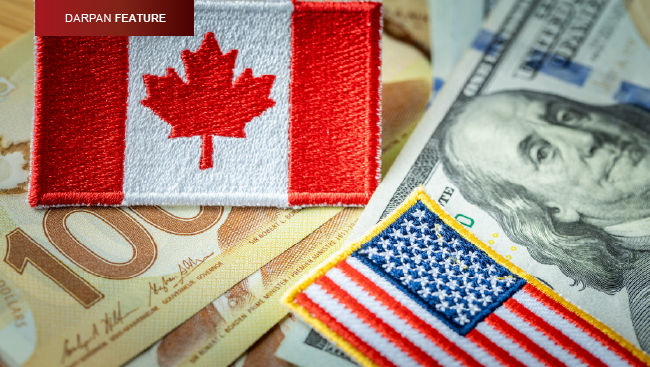
The overall economy will largely remain in the uncertain zone. For weeks, Canada was hopeful of a trade deal with the U.S. However, a tariff ad from the 1980s, broadcast across Canada, has prompted Trump to end negotiations. The U.S. accounts for at least two-third of Canada’s total trade value. In the absence of any deal, Trump’s tariffs will continue to negatively impact Canada’s exports. This could lead to a reduction in capital investments and a cut in overall economic output. Nevertheless, the consensus among economists points to the country avoiding a full recession. Regulatory reforms, a fiscal bailout, and more pro-trade policies cannot be ruled out in 2026.
2) Housing Sector: Good Days Ahead
Buying a house is increasingly becoming a nightmare in Canada. But 2026 may offer a ray of hope for primary homebuyers. From 2026, Canada will see new mortgage qualification rules, which are expected to make it difficult for investors to finance multiple properties through personal income. Instead, lenders will assess any property’s debt service based on rental income, not the borrower’s earnings. These new rules aim to prevent the housing market from becoming a speculative bubble. Moreover, Canada is expected to extend its restrictions on foreigners buying properties in the country. These two factors could ease the competition for homes, soften prices, and help many Canadians buy their dream home for the very first time.
3) Stock Market Bull Run to End?
Contrary to the struggling real economy, the Canadian stock market continued to witness a bull run in 2025, reaching an all-time high of 30,808.10 in October. In fact, the TSX (Toronto Stock Exchange index) has risen 67% since 2022. Two factors may have primarily helped the Canadian market this year. One: Cautious investors may have parked some of their funds in Canada as a hedge against uncertainty in the U.S. Two: A weakening U.S. Dollar vis-à-vis the Canadian Dollar may have nullified the additional currency benefit for American investors.
But 2026 may not be as good for the market. The TSX is a commodity-heavy index. Hence, geopolitical uncertainties can trigger volatility in metals, crude, and other commodities, which could drag the index. Any breakdown in Sino-U.S. ties and continuing deadlock over a trade deal with the U.S. will also weigh on Canada’s market. Finally, if the AI bubble bursts in 2026, the U.S. market will also pull the Canadian market down.
4) Cost of Living: Pain to Persist?
The cost of living has been rising in Canada, primarily driven by rising food inflation. According to Statistics Canada, inflation for consumer goods and services increased in September 2025, with prices rising by 2.4% compared to the same period in 2024. A large part of the cost-of-living pain stems from the ongoing tariff tensions. For instance, many small Canadian businesses have been passing their mounting costs to customers.
To make matters worse, the labor market has been relatively weak this year, with unemployment reaching a nine-year high in August. This means families have less disposable income to spend amid rising costs. The employment outlook for 2026 does not look very great either. If the current uncertainty around tariffs continues, the cost-of-living crisis is likely to persist in 2026. Subsequently, the ball will be in the Bank of Canada’s court. It could pause the rate cut cycle if inflation breaches the 1-3% range, but pausing (or raising) rates could also damage economic recovery.
5) Changing Tide of Trade: Canada’s Pivot to Asia
Canada’s trade with the U.S. has always remained robust. However, Trump’s tariff tantrums have compelled Canada’s policymakers to realize the importance of trade diversification.
Things have begun to change in 2025, albeit slowly. Canada is still largely tied to the U.S. economy. The year 2026 could offer several opportunities for Ottawa to diversify its trade ties. These trade opportunities, however, won’t come from the Global North. They will come from Asia, especially China and the Indo-Pacific (read ASEAN). The Indo-Pacific region is Canada’s second-largest trading partner, with over $260 billion in merchandise trade. Yet, it still represents only 10% of the country’s exports. The ASEAN region is also a major consumer market, with 700 million people and an economy worth over $5 trillion. With PM Carney actively engaging with the ASEAN bloc and expressing his willingness to deal with China’s Xi Jinping (arguably the second-most powerful man on earth), 2026 could see Canada pivoting to Asia.