

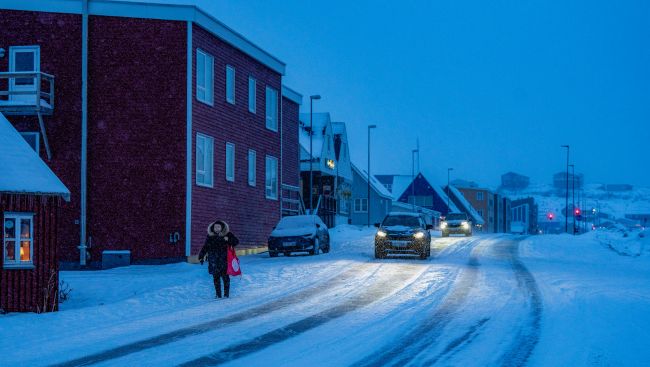
Canada's closest physical neighbours are in an escalating dispute that risks breaking the military alliance that has protected the nations of the North Atlantic for decades.
U.S. President Donald Trump keeps talking about annexing Greenland, the Danish territory where Canada is about to open a diplomatic mission.
Here's a look at why diplomacy, climate change and natural resources have put Greenland in the global spotlight — and what this war of words could mean for Canadian security.
Why is Greenland Danish?
Greenland is a mineral-rich island, 80 per cent of which lies above the Arctic Circle. It's home to about 56,000 people, mostly Inuit. The island has a measure of autonomy within the Kingdom of Denmark, which handles its foreign policy.
Missionaries colonized the land mass in the 1700s when Denmark and Norway had a single monarch, and Greenland became Danish territory when the monarchy broke apart in 1814. It is a self-governing territory of Denmark — a longtime U.S. ally that has repeatedly rejected Trump's talk of purchasing or even annexing the territory.
Greenland’s own government also opposes U.S. designs on the island, saying the people of Greenland will decide their own future.
In 2015, the Arctic Human Development Report found social issues in Greenland similar to those in Nunavut, such as a wide gap in health outcomes.
Why is Greenland strategic?
Greenland has been critical to the defence of North America since the Second World War, when the U.S. occupied the territory to ensure it didn’t fall into the hands of Nazi Germany. It's also vital territory for the protection of North Atlantic shipping lanes.
Greenland guards part of what is known as the GIUK Gap, the area between Greenland, Iceland and the U.K. where NATO monitors Russian naval movements in the North Atlantic. Analysts have described the area as strategically important for shipping and an outer line of defence against threats to the U.S.
The U.S. Department of Defence operates the remote Pituffik Space Base in northwestern Greenland, which was built after the U.S. and Denmark signed the Defence of Greenland Treaty in 1951. The base supports U.S. and NATO missile warning, missile defence and space surveillance operations.
Thomas Crosbie, an associate professor of military operations at the Royal Danish Defence College, said an American takeover wouldn't improve upon Washington’s current security strategy.
"There (are) no benefits to them because they already enjoy all of the advantages they want," he told The Associated Press.
"If there’s any specific security access that they want to improve American security, they’ll be given it as a matter of course, as a trusted ally. So this has nothing to do with improving national security for the United States."
How is climate change heating things up?
The Arctic was largely an area of international co-operation after the end of the Cold War. But climate change is thinning Arctic ice and opening up the prospect of new shipping routes through the Northwest Passage.
That has reignited competition with Russia — which has restored old Soviet infrastructure and built new military facilities in the region — and China, which claims to be a "near-Arctic state."
European leaders’ concerns about the Arctic were heightened when Russia escalated its 2014 annexation of parts of Ukraine to a full-scale invasion in 2022.
Russian President Vladimir Putin said last year Moscow is worried about NATO’s activities in the Arctic and will respond by strengthening the capability of its armed forces there. He also said Moscow was holding the door open to broader international co-operation in the region.
What about minerals?
Greenland is also a rich source of rare earth elements, 17 chemically similar metals that are a key component of cellphones, computers, batteries and other high-tech items that are set to drive the world’s economy in the coming decades.
That has attracted the interest of the U.S. and other Western powers eager to reduce China's dominance of markets for these critical minerals. Currently China mines almost two-thirds of the world's supply of rare earth elements, and has threatened export restrictions.
Development of Greenland’s mineral resources is challenging because of the island’s harsh climate, while strict environmental controls have served as an additional hurdle for potential investors.
Why is Canada setting up shop?
Foreign Affairs Minister Anita Anand is set to formally open a Canadian consulate in Greenland's capital, Nuuk, Friday — a move that has garnered attention following Trump's threats but had been planned before his return to office.
The consulate is part of an Arctic foreign policy released in late 2024 that called for more defence and infrastructure investment in the North and a new consulate in Anchorage, Alaska. The policy said the Nuuk consulate would boost research and commercial ties.
Anand has said that she urged NATO Secretary-General Mark Rutte to get the alliance to focus more on the North.
"Canada's exported our defence and military spending over two world wars to Europe. It is time for the North Atlantic Treaty Organization to focus as well on the North Atlantic and the Arctic," she told the Canadian Club in Toronto on Dec. 12.
What has Trump said?
Trump mused during his first term about purchasing Greenland. Danish Prime Minister Mette Frederiksen called the idea "absurd," leading Trump to cancel a state visit planned for Copenhagen in 2019.
Trump has been more vocal in his second term.
"We need Greenland from the standpoint of national security, and Denmark is not going to be able to do it," Trump said following the capture of Venezuelan President Nicolas Maduro by U.S. forces.
His comments clearly have rattled NATO allies. In early January, Trump told reporters they would talk again "about Greenland in 20 days."
"Greenland is covered with Russian and Chinese ships all over the place," he claimed. The Danish Institute for International Studies says those nations have ships in the Arctic but not within view of Greenland.
Earlier this month, the White House said acquiring Greenland is an "important foreign policy goal, and of course, utilizing the U.S. military is always an option at the commander-in-chief's disposal."
Trump has only recently backed down from threats to use force to acquire the Danish territory.
Frederiksen has said an American takeover of Greenland would spell the end of the NATO military alliance, which has secured the U.S., Canada and Europe from threats emanating from Russia and other antagonists since the end of the Second World War.
Roland Paris, who leads the University of Ottawa's graduate school of international affairs, wrote on the platform X that any U.S. move to take over Greenland would be "a seismic event" that would force Canada "to rethink every aspect of its relations with the U.S."
Trump's threats dominated conversations at the World Economic Forum last month in Davos, Switzerland, where Prime Minister Mark Carney gave a widely praised speech urging middle powers to work together against great power hegemony.
Trump also has talked repeatedly of somehow making Canada a U.S. state. People in Nuuk have been spotted wearing clothing branded with the message "Greenland is not for sale" — similar to a ball cap made famous in Canada by Ontario Premier Doug Ford.
How are Danes responding?
Since Trump's return to the White House, Denmark has moved to strengthen its military presence around Greenland and in the wider North Atlantic.
Last year, Copenhagen announced it would be spending the equivalent of more than $3 billion to "improve capabilities for surveillance and maintaining sovereignty in the region" of Greenland and the Faroe Islands.
The plan would see Denmark acquire three new Arctic naval vessels, two additional long-range surveillance drones and satellite capacity.
Denmark's Joint Arctic Command, headquartered in Nuuk, is tasked with the "surveillance, assertion of sovereignty and military defence of Greenland and the Faroe Islands," according to its website. It has smaller satellite stations across the island.
The Sirius Dog Sled Patrol, an elite Danish naval unit that conducts long-range reconnaissance and enforces Danish sovereignty in the Arctic wilderness, is also stationed in Greenland.
Trump has dismissed Danish efforts as adding "one more dog sled" to the Arctic territory’s arsenal.
Last June, Denmark widened a previous military agreement to allow U.S. military bases on Danish soil and give Americans more access to Danish airbases. Copenhagen says this agreement could be repealed if U.S. tries to annex Greenland.


