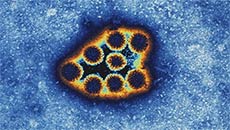
A COVID-19 vaccine from Pfizer has arrived in Ontario and Quebec, with the first inoculations rolling out Monday in Toronto, Montreal, and Quebec City.
The first batch of doses of Pfizer-BioNTech’s COVID-19 vaccine have arrived in Canada. pic.twitter.com/xSvwkRROKo
— Justin Trudeau (@JustinTrudeau) December 14, 2020
Canada is set to receive 249,000 doses of the drug from the U.S. pharmaceutical giant and its German partner BioNTech by the end of the month and four million total doses — enough to vaccinate two million people — by March.
Here's what we know about today's vaccinations and Pfizer's product:
WHO IS GETTING VACCINATED FIRST?
Five front-line workers were the first Ontarians to receive the vaccine at one of Toronto's hospitals on Monday.
Ontario had 6,000 doses delivered over the weekend and plans to vaccinate approximately 2,500 more health-care workers. Each person who is vaccinated needs two doses 21 days apart.
In Quebec, residents of long-term care homes in Montreal and Quebec City will be the first to receive the shots, followed by staff.
HOW DOES THE VACCINE WORK?
Pfizer developed its vaccine with a novel technique of using messenger RNA (mRNA), which essentially teaches our cells how to make the coronavirus's spike protein and trigger an immune response if we become infected with the virus in the future.
Pfizer's vaccine uses a synthetically-produced mRNA that's packaged in a fat, or lipid, coating. When injected into the arm muscle, the lipid hooks onto cells and dumps the mRNA there. It's then translated into protein to make the antibody.
Another leading vaccine candidate from Moderna also uses mRNA. One from AstraZeneca uses a non-replicating viral vector — a virus that has been stripped of its genetic material and replaced with the spike protein gene of the coronavirus. That viral vector makes an mRNA molecule, and from there the protein and antibodies.
HOW EFFECTIVE IS IT?
Clinical trials revealed a 95 per cent efficacy rate in preventing SARS-CoV-2 infection beginning one week after the second dose. Health Canada specifies on its website that people may not be protected against COVID-19 until at least seven days after the second dose.
The findings are based on studies in about 44,000 participants of a controlled trial, but epidemiologists and public health officials have said results could differ in a broader population in the real world.
Questions remain about how long immunity lasts, whether a vaccinated person can still transmit the disease, and what its impact will be on rising deaths and hospitalizations.
Mahyar Etminan, an epidemiologist at the University of British Columbia, cautions against overestimating the significance of a 95 per cent efficacy rate, which he says refers to a relative risk reduction of testing positive for COVID-19, not a reduction in the absolute number of COVID-19 infections.
"My worry is that people who hear that think that if 100 people are vaccinated, 95 of them are going to be free of COVID and not get COVID. That's not what the numbers suggest at all."
Still, if a large population is inoculated, he allows that can have significant impact, especially in high risk groups.
"The more people you vaccinate the more people may benefit, and the benefit may be even higher in a real population, in a real-life setting,” says Etminan, an associate professor in the departments of ophthalmology and medicine.
WHAT ARE THE SIDE EFFECTS?
Health Canada says the side effects from Pfizer's clinical trials were found to be "mild or moderate'" and included things like pain at the site of injection, body chills and feeling tired and feverish.
The organization says those are common side effects of many vaccines, and "do not pose a risk to health."
"As with all vaccines, there's a chance that there will be a serious side effect, but these are rare," the website says. "A serious side effect might be something like an allergic reaction."
WHAT ARE THE HURDLES FACING DISTRIBUTION?
Pfizer's vaccine, like Moderna's and AstraZeneca's, requires two doses injected roughly three weeks apart.
Tracking will become particularly important with a two-dose vaccine, to make sure people are going back to their doctor or pharmacy to get their second dose, and to ensure they're receiving the right vaccine if more than one option is available.
Storage could also prove problematic with Pfizer's product, which requires ultra-low freezers that can keep it at minus 70 C until a short time before it's injected. Moderna's needs a temperature around minus 20 C — about the same as a regular freezer.
Pfizer and Moderna need cooler temperatures for their vaccines because of the instability of the mRNA. AstraZeneca's vaccine, meanwhile, can be stored in a fridge.