

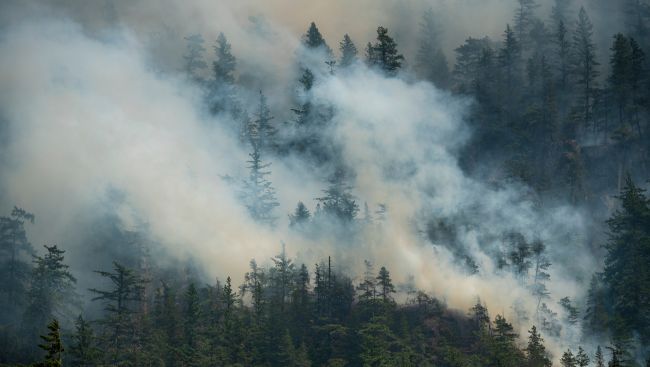
The wildfires that are flaring up across Canada again are one of the reasons public safety should be added to CBC/Radio-Canada’s mandate, a new report from a research centre at McGill University argues.
The report says other public media around the world are incorporating national emergency preparedness and crisis response into their role, and recommends that aspect of the CBC’s mandate be formalized and strengthened.
"For us in Canada, wildfires and floods have sort of crept up on us in the last five years as part of an everyday reality," said Jessica Johnson, a senior fellow at McGill University’s Centre for Media, Technology and Democracy, who co-authored the report released Wednesday.
"They were always a reality if you were living in heavily forested areas. But now the smoke from some parts is affecting the whole country and even our neighbours."
On Monday and Tuesday, special air-quality statements caused by wildfire smoke were in effect in many areas of the country, with the government warning residents to consider limiting time outdoors and watch for symptoms of smoke exposure. Thousands of people in Manitoba, Saskatchewan and Alberta have been forced out of their homes this spring and summer due to the wildfires.
The report says previous research that looked at false information during wildfires in Canada found that on social media, "influential right-wing and anti-establishment groups blamed arson by green terrorists and the government for the fires, which further fuelled a distrust in the media in the moments when accurate information was critically important."
Johnson said in the interview that "if there's misinformation online that's telling people it's just a hoax, you don't need to evacuate, that puts people's lives at risk."
There are also wider concerns about misinformation. Facebook, a platform many have come to rely on for information, blocks news content in Canada, while some Canadians are increasingly turning to generative AI for information, even though such systems can make mistakes and provide false information.
"We've lost a lot of the healthy sources in addition to the arrival of the unreliable sources of information," Johnson said.
While some countries in recent years have been changing the mandates of their public media in response to the climate crisis, she explained, others have been doing it in response to security concerns — for instance, Baltic countries looking at their proximity to Russia.
The head of the recent public inquiry into foreign interference concluded that misinformation and disinformation are an existential threat to Canada’s democracy, Johnson noted.
"So you start putting it all together and you realize public media starts to look not like a nice to have. It starts to like a part of your communications infrastructure," Johnson said.
During this year’s federal election, the Liberals promised to increase the CBC’s funding by an initial $150 million annually, and to make a number of changes to the its mandate. That includes adding "the clear and consistent transmission of life-saving information during emergencies."
Johnson said it’s important to ensure that the CBC isn’t just repeating information provided by the government, but that it’s able to question and hold the government to account.
Another key element is ensuring the public broadcaster has the ability to do the work it’s tasked with, especially at the local level.
Johnson gave the example of residents in an area facing a wildfire, who should be able to find information about potential evacuations affecting their community, instead of media reports being focused on broadly informing Canadians across the country about the fire.
She noted there are parts of the country where, when it comes to media presence, the CBC "is kind of the only game in town or in the nearest town."
Johnson said one option is for the CBC to partner with local independent journalists, a model which has been implemented in Britain and "could be a great model for Canada."
Changing technology also means there are technical issues to consider — internet and cellphone networks can go down, and many people don’t have traditional TV or radios anymore.
"I think it's a government responsibility to do that work, whether it involves research, and say, are we actually prepared, and who needs to be involved in a conversation about making sure that we're prepared?"
The CRTC, Canada’s broadcast and telecom regulator, announced Tuesday that it’s launching a consultation on how to improve Canada’s public alert system. It requires cellphone, cable and satellite providers, and TV and radio broadcasters to distribute emergency alerts.
Johnson’s report concludes that Canada’s emergency preparedness needs are changing, and that means "CBC-Radio Canada may need to be structured to serve the country in ways it hasn’t had to in the past."
Picture Courtesy: THE CANADIAN PRESS/Tijana Martin


