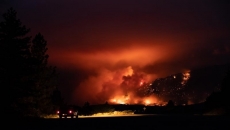
The blazes that have scorched several parts of Western Canada have affected wildlife populations incinerating their habitat, which may take many years to recover, an expert says.
Karen Hodges, a professor of conservation ecology at the University of British Columbia, said just as human homes are in the path of the fires, so is animal habitat.
Scientists are most worried about old-growth forests in fire areas, which are home to the Canada lynx, the marten, fishers, caribou and northern goshawk, she said.
"Then I start getting worried about most of the predators, because they need those big ranges to obtain enough prey and keep enough of a population on the landscape," Hodges said in an interview Monday.
"And as we start seeing big fire after big fire, that's going to be decades of hundreds of square kilometres that's not great habitat for some time to come."
Her team has recently published papers on the impact of wildfires on small animals such as martens, snowshoe hares and mice, but research is lacking on wildlife habitat ravaged by fires, she said.
The BC Wildfire Service said nearly 250 blazes are burning across the province, down from about 270 a week ago thanks to cooler, damp weather.
Premier John Horgan called this year a "challenging" fire season, which included record-breaking heat.
While there has been a bit of a reprieve because of the weather, he said "we're a long way from out of the fire season."
The amount of land scorched in 2017 was a little over 12,160 square kilometres, and in 2018 it was more than 13,542 square kilometres. So far this year, about 8,600 square kilometres of land burned.
The Ministry of Forests said in a statement that it takes at least six months to complete assessments on the impact of fires on wildlife.
"The outcomes for wildlife are also highly dependent on the scale and intensity of individual fires," it said.
"The impacts on wildlife of the large-scale, intense wildfires that have been occurring throughout the west in recent years are not well understood."
Hodges said smaller animals such as voles and mice may find it harder to escape wildfires compared with larger mammals such as wolves or bears.
But smaller animals can make a home in the destroyed areas faster than the larger ones because they need less resources, she said.
"They can, you know, hide among the patches that are still less burned and that sort of thing," Hodges said.
"Whereas, a bear or a cougar needs a bit of habitat, and if the whole thing burned, it's going to take longer for them to be able to move back into the area."
Fire is a natural part of this habitat, and some species benefit from fire, such as some woodpeckers and fireweed, she said.
"There's a handful of plants, there's a handful of animals, insects, that just love the newly burned habitat."
But the fires burning now are bigger and hotter where the season starts early and ends later, she said, noting there are at least six to eight weeks still to go this year.
"So, we really are seeing a big reset of habitats."
Hodges said she is most concerned about the lack of endangered species laws to protect animals in such a fast-changing environment.
"We expect more flood. We expect more fires. It takes decades to regrow forests once they have been burned or harvested, so wildlife are taking a big hit."
Another major threat to species is post-fire salvage logging, which slows the regrowth of habitat for many animals, she said.
"We need to have decision-making space to ensure that these disturbances don't drive species over the edge."