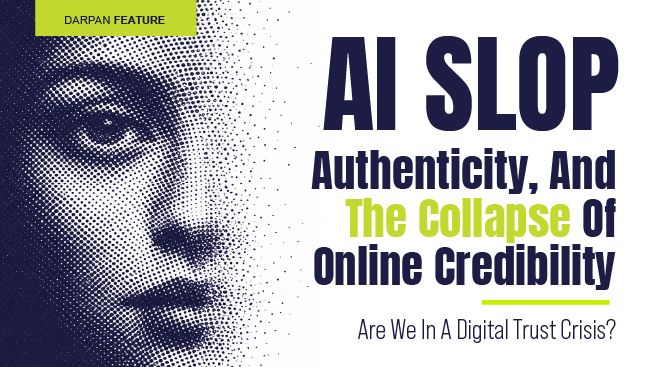
AI-generated content is rapidly reshaping the online information ecosystem, but not in the simple way many people assume. The more pressing shift is not just that machines can now produce text, images, and videos at scale, but that audiences are increasingly unsure about what, or who, they are even looking at. The rise of "AI slop," a term used to describe the flood of low-quality AI-generated content circulating online, has only deepened that uncertainty. What emerges is not just a content problem, but a trust crisis.
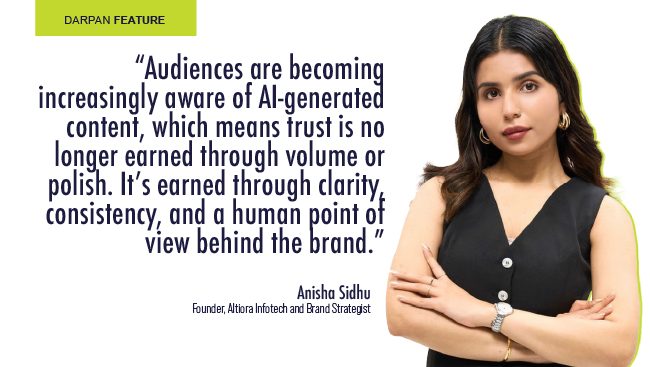
As Anisha Sidhu, business leader in AI and tech, brand strategist, and founder of Altiora Infotech, puts it, “We’re moving from a world where ‘content output’ was the differentiator, to one where intent, originality, and lived perspective matter more than ever.” From a business perspective, AI-generated content may not be replacing authenticity. Instead, it may be raising the bar for it. Sidhu adds, “Audiences are becoming increasingly aware of AI-generated content, which means trust is no longer earned through volume or polish. It’s earned through clarity, consistency, and a human point of view behind the brand.”
In her view, the brands that will stand out are not those producing the most content, but those using AI deliberately, where AI is used to scale execution, but human judgment stays at the core of messaging, storytelling, and positioning. In that sense, AI does not remove the need for creativity or strategy but intensifies it. Moreover, this shift also has implications for how organizations think about people and teams.
Sidhu explains, “The value of teams is shifting from production-heavy roles to thinking, directing, and interpreting roles, people who can guide systems rather than just execute tasks.” She frames this as a structural change in hiring and organizational design, where the most valuable contributors are those who can translate between technology and meaning, rather than just generate output at scale.
At the same time, AI opens significant opportunities for speed and precision. It allows businesses to personalize communication, accelerate creative testing, streamline recruitment processes, and create tighter feedback loops between audience behavior and decision-making. However, a new tension is also introduced. When everyone has access to similar tools, differentiation becomes harder to maintain.
Sidhu highlights this balance directly: “The biggest opportunity is clear: scale with precision. The biggest risk is loss of differentiation through over-automation.” Without strong editorial direction or a clearly defined brand identity, she argues, organizations risk producing work that becomes increasingly interchangeable: “If businesses rely too heavily on AI without a strong brand voice, editorial direction, or cultural understanding, they risk becoming indistinguishable in the market.”
Beyond opportunity and optimization, Kiran Singh, an award-winning journalist, describes how the erosion of trust in media has been building long before generative AI became mainstream. Reflecting on his experience reporting during the pandemic, he says, “It taught me resilience, the importance of collaborating with fellow reporters in good faith, but most importantly, I learnt how nationwide and global campaigns can be launched to erode trust in the news.”
He emphasizes, “Labeling tough questions as ‘fake news’ was simply the beginning of this erosion of trust.” For Singh, AI is not the origin of the problem, but it has accelerated an existing vulnerability in how people consume and interpret information. Singh also points to the broader media environment: “This, coupled with Meta’s ban on sharing news on social media platforms in Canada, has enabled alternative channels to label themselves as ‘media’ and try to pass their slop as ‘news.’” The result, he suggests, is a fragmented information landscape where the boundaries between journalism, commentary, and synthetic content are becoming harder to identify.
One of Singh’s key worries is how this affects younger audiences. “While the younger generation may be less prone to taking any ‘news’ at face value, we are also the ones consuming more and more of it, scrolling fast on multiple apps on our handheld devices,” he asserts. This can contribute to political apathy and disengagement, where users no longer pause to question whether what they are seeing is accurate or fabricated. He is clear that journalism cannot be replaced by automation: “Gathering news stories and reporting is an exercise in critical thinking which simply cannot be outsourced to generative AI models.”
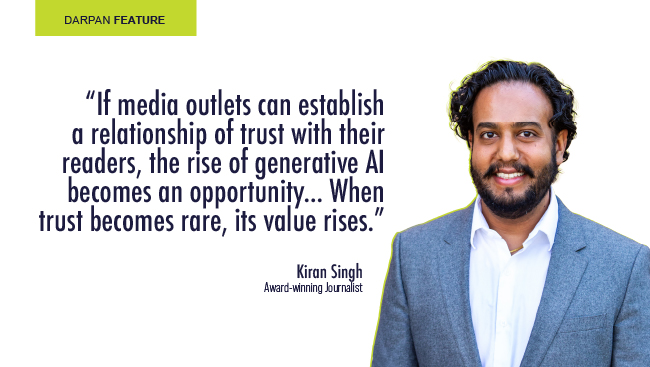
At the same time, Singh acknowledges that the crisis of trust also creates a potential opportunity for credible outlets to differentiate themselves more clearly. “If media outlets can establish a relationship of trust with their readers, the rise of generative AI becomes an opportunity,” he details. “When trust becomes rare, its value rises.” This, he suggests, could even reshape the economics of journalism, encouraging audiences to financially support outlets they believe are consistently reliable, especially if those outlets position themselves clearly against automated or synthetic content.
Undoubtedly, AI is simultaneously expanding what is possible and complicating what is believable. It is accelerating output while demanding stronger human direction. It is increasing efficiency in some areas while intensifying concerns about credibility and misinformation. The common thread across all use cases, however, is trust, and how difficult it becomes to maintain when the signals of authenticity are no longer obvious. Ultimately, the question is not only what is real, but whether we are willing to invest the time, institutions, and critical thinking required to find out.