Saturday, March 28, 2026
ADVT 
Tech

Coming Soon, lighter batteries with more life

Darpan News Desk IANS, 28 Jul, 2014 07:42 AM
    You may soon be able to have a cell phone with double or triple the battery life as researchers have taken a big step towards accomplishing what battery designers have been trying to do for decades - design a pure lithium anode.
     
    All batteries have three basic components: an electrolyte to provide electrons, an anode to discharge those electrons, and a cathode to receive them.
     
    What we call lithium batteries today do not have lithium in the anode. An anode of pure lithium would be a huge boost to battery efficiency.
     
    "Of all the materials that one might use in an anode, lithium has the greatest potential. Some call it the Holy Grail," said Yi Cui, a professor of material science and engineering at Stanford University in the US.
     
    "It is very lightweight and it has the highest energy density. You get more power per volume and weight, leading to lighter, smaller batteries with more power," Cui added.
     
    But engineers have long tried and failed to reach this Holy Grail.
     
    Researchers say that lithium's expansion during charging is "virtually infinite" relative to the other materials.
     
    Its expansion is also uneven, causing pits and cracks to form in the outer surface, like paint on the exterior of a balloon that is being inflated.
     
    The resulting fissures on the surface of the anode allow the precious lithium ions to escape, forming hair-like or mossy growths, called dendrites. Dendrites, in turn, short circuit the battery and shorten its life.
     
    To solve these problems the researchers built what they call nanospheres, a protective layer of interconnected carbon domes on top of their lithium anode.
     
    Made of amorphous carbon, the nanosphere is chemically stable, yet strong and flexible so as to move freely up and down with the lithium as it expands and contracts during the battery's normal charge-discharge cycle.
     
    The study appeared in the journal Nature Nanotechnology.

    MORE Tech ARTICLES

    Here's an iPhone app that paints your photos into masterpieces

    Here's an iPhone app that paints your photos into masterpieces
    The app now simulates the spreading and bleeding of the pigment onto the canvas - with dedicated properties for the virtual paper, the pigment, the brushes, the water and so on

    Here's an iPhone app that paints your photos into masterpieces

    3D-printed replica for a safe liver transplant created

    3D-printed replica for a safe liver transplant created
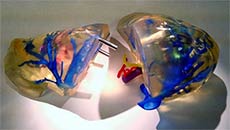
    The 3D-printed liver replicas, made of transparent material threaded with coloured arteries and veins, could help surgeons prevent complications while performing liver transplants or removing tumours, a path-breaking research shows.

    3D-printed replica for a safe liver transplant created

    First Look: World's first winemaker machine for your kitchen!

    First Look: World's first winemaker machine for your kitchen!
    Three cheers for wine lovers out there. Here comes a new machine that can turn water, grape concentrate, yeast and a finishing powder into wine in your kitchen in flat three days.

    First Look: World's first winemaker machine for your kitchen!

    Who is smarter, man or woman? It's just a brain, stupid!

    Who is smarter, man or woman? It's just a brain, stupid!
    The big debate about who is smarter, man or woman, has now been laid to rest. There is nothing like a boy's or a girl's brain, and no scientific evidence to prove that they are wired differently, according to an expert.

    Who is smarter, man or woman? It's just a brain, stupid!

    Samsung wearable device to turn hands into keyboard

    Samsung wearable device to turn hands into keyboard
    As the race for wearable computer devices heats up with the entry of Google Glass, a report suggests that Samsung is also working on a wearable device that can turn hands into a virtual keyboard.

    Samsung wearable device to turn hands into keyboard

    Indian-origin engineers create device for faster wireless technology

    Indian-origin engineers create device for faster wireless technology
    Using an inexpensive Rs.3,600 inkjet printer, two Indian-origin electrical engineers at the University of Utah have for the first time produced microscopic structures that use light in metals to carry information

    Indian-origin engineers create device for faster wireless technology