Sunday, March 29, 2026
ADVT 
Tech

Coming Soon, lighter batteries with more life

Darpan News Desk IANS, 28 Jul, 2014 07:42 AM
    You may soon be able to have a cell phone with double or triple the battery life as researchers have taken a big step towards accomplishing what battery designers have been trying to do for decades - design a pure lithium anode.
     
    All batteries have three basic components: an electrolyte to provide electrons, an anode to discharge those electrons, and a cathode to receive them.
     
    What we call lithium batteries today do not have lithium in the anode. An anode of pure lithium would be a huge boost to battery efficiency.
     
    "Of all the materials that one might use in an anode, lithium has the greatest potential. Some call it the Holy Grail," said Yi Cui, a professor of material science and engineering at Stanford University in the US.
     
    "It is very lightweight and it has the highest energy density. You get more power per volume and weight, leading to lighter, smaller batteries with more power," Cui added.
     
    But engineers have long tried and failed to reach this Holy Grail.
     
    Researchers say that lithium's expansion during charging is "virtually infinite" relative to the other materials.
     
    Its expansion is also uneven, causing pits and cracks to form in the outer surface, like paint on the exterior of a balloon that is being inflated.
     
    The resulting fissures on the surface of the anode allow the precious lithium ions to escape, forming hair-like or mossy growths, called dendrites. Dendrites, in turn, short circuit the battery and shorten its life.
     
    To solve these problems the researchers built what they call nanospheres, a protective layer of interconnected carbon domes on top of their lithium anode.
     
    Made of amorphous carbon, the nanosphere is chemically stable, yet strong and flexible so as to move freely up and down with the lithium as it expands and contracts during the battery's normal charge-discharge cycle.
     
    The study appeared in the journal Nature Nanotechnology.
    MORE Tech ARTICLES

    Camera that detects skin cancer in two seconds!

    Camera that detects skin cancer in two seconds!
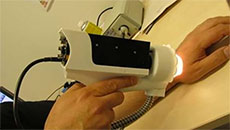
     Finnish researchers have developed a new camera that is able to detect early stages of skin cancer in matter of seconds.

    Camera that detects skin cancer in two seconds!

    Game changer? Two-screen smart phone is here

    Game changer? Two-screen smart phone is here
    Developed by a Moscow firm, YotaPhone would be the first to be available in the US when it goes on sale later this year, before hitting Asian markets

    Game changer? Two-screen smart phone is here

    WhatsApp to introduce voice calls in second quarter

    WhatsApp to introduce voice calls in second quarter
    World's biggest mobile messaging service WhatsApp intends to add voice calling feature to its free messaging service in the second quarter of 2014

    WhatsApp to introduce voice calls in second quarter

    Facebook to acquire WhatsApp for $19 bn

    Facebook to acquire WhatsApp for $19 bn
    In an acquisition move bigger than Google, Microsoft or Apple have ever done, Facebook has announced to buy mobile messaging service WhatsApp for $19 billion.

    Facebook to acquire WhatsApp for $19 bn

    Jot down etiquettes for wearing Google Glass

    Jot down etiquettes for wearing Google Glass
    With an aim to address how people should use Google's wearable technology, the firm has revealed the first official etiquette kit for its Glass device

    Jot down etiquettes for wearing Google Glass

    Google to create android applications in Indian languages

    Google to create android applications in Indian languages
    Google Wednesday said it will host a two-day workshop in Bangalore later this week focused on designing and creating android applications in Indian languages.

    Google to create android applications in Indian languages