Monday, December 22, 2025
ADVT 
Tech

Indian American scientist develops path to brighter LCD displays

Darpan News Desk IANS, 24 Nov, 2014 11:07 AM
    Researchers led by an Indian-American have developed a polarising filter that can result in mobile device displays that last much longer on a single battery charge and cameras that can shoot in dim light.
     
    Led by Utah Univesity electrical and computer engineering associate professor Rajesh Menon, electrical researchers created the filter by etching a silicon wafer with nanoscale pillars and holes using a focused gallium-ion beam, a university release said.
     
    Polarisers are indispensable in digital photography and LCD displays, but they block enormous amounts of light, wasting energy and making it more difficult to photograph in low light.
     
    "This new concept in light filtering can perform the same function as a standard polariser but allows up to nearly 30 percent more light to pass through," said Menon.
     
    Polarisers are widely used by photographers to reduce glare in the image. They also are used in LCD displays to regulate what light passes through to create images on the screen.
     
    "When you take a picture and put the polarised filter on, you are trying to get rid of glare," Menon said. "But most polarisers will eliminate anywhere from to 60 to 70 percent of the light. You can see it with your eyes."
     
    Yet with Menon's new polariser, much of the light that normally is reflected back is instead converted to the desired polarised state.
     
    The Utah researchers have been able to pass through about 74 percent of the light, though their goal is to eventually allow all of the light to pass through.
     
    LCD displays on devices such as smartphones and tablets have two polarisers that ultimately throw away most of the light when working with the liquid crystal display.
     
    "If one can increase that energy efficiency, that is a huge increase on the battery life of your display. Or you can make your display brighter," Menon said.
     
    Menon said the first marketable applications of this technology could be available in five to 10 years.
     
    The technology also could be a boon for photographers who want to bring out more detail in their pictures while shooting in low-light situations and for scientists using microscopes and telescopes to visualise obscure phenomenon, he said.
    MORE Tech ARTICLES

    Amazing! An Umbrella that gives you rain data via smart phone!

    Amazing! An Umbrella that gives you rain data via smart phone!
    Though rains are still some days away, buying this umbrella that can collect rain data won't be a bad idea.

    Amazing! An Umbrella that gives you rain data via smart phone!

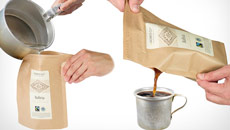
    Now, a disposable 'coffee machine' at your service

    Now, a disposable 'coffee machine' at your service
    If a cup of filter coffee is what you need the most to get your day started, you no longer have to worry about travelling to the nearest coffee shop. A Danish designer has come up with a disposable coffee machine that works just like a tea bag for coffee.

    Now, a disposable 'coffee machine' at your service

    Men reinforce gender stereotypes even in online avatars

    Men reinforce gender stereotypes even in online avatars
    Even when men take female avatars in some video games, they do not try to mask their gender and instead reinforce gender stereotypes through their gestures, a study showed.

    Men reinforce gender stereotypes even in online avatars

    Distant tiny spinning star discovered

    Distant tiny spinning star discovered
    Using the ‘empty’ space between stars and galaxies that is made up of sparsely spread charged particles as a giant lens, researchers have made a measurement of a distant rotating neutron star that is believed to be the most precise till now.

    Distant tiny spinning star discovered

    Automated cockpits may drive pilots crazy!

    Automated cockpits may drive pilots crazy!
    Automation in the cockpits are designed to free pilots from paying attention to the mundane flight tasks and allow them to concentrate on the overall flight, but they can also drive the pilots crazy, indicated a study.

    Automated cockpits may drive pilots crazy!

    Soon, Boeing spacecraft to send astronauts in space

    Soon, Boeing spacecraft to send astronauts in space
    Leveraging its expertise in the space-bound flight operations, Boeing has unveiled a concept of a manned spaceflight that is expected to send astronauts into space by 2017.

    Soon, Boeing spacecraft to send astronauts in space