Monday, December 22, 2025
ADVT 
Tech

Indian American scientist develops path to brighter LCD displays

Darpan News Desk IANS, 24 Nov, 2014 11:07 AM
    Researchers led by an Indian-American have developed a polarising filter that can result in mobile device displays that last much longer on a single battery charge and cameras that can shoot in dim light.
     
    Led by Utah Univesity electrical and computer engineering associate professor Rajesh Menon, electrical researchers created the filter by etching a silicon wafer with nanoscale pillars and holes using a focused gallium-ion beam, a university release said.
     
    Polarisers are indispensable in digital photography and LCD displays, but they block enormous amounts of light, wasting energy and making it more difficult to photograph in low light.
     
    "This new concept in light filtering can perform the same function as a standard polariser but allows up to nearly 30 percent more light to pass through," said Menon.
     
    Polarisers are widely used by photographers to reduce glare in the image. They also are used in LCD displays to regulate what light passes through to create images on the screen.
     
    "When you take a picture and put the polarised filter on, you are trying to get rid of glare," Menon said. "But most polarisers will eliminate anywhere from to 60 to 70 percent of the light. You can see it with your eyes."
     
    Yet with Menon's new polariser, much of the light that normally is reflected back is instead converted to the desired polarised state.
     
    The Utah researchers have been able to pass through about 74 percent of the light, though their goal is to eventually allow all of the light to pass through.
     
    LCD displays on devices such as smartphones and tablets have two polarisers that ultimately throw away most of the light when working with the liquid crystal display.
     
    "If one can increase that energy efficiency, that is a huge increase on the battery life of your display. Or you can make your display brighter," Menon said.
     
    Menon said the first marketable applications of this technology could be available in five to 10 years.
     
    The technology also could be a boon for photographers who want to bring out more detail in their pictures while shooting in low-light situations and for scientists using microscopes and telescopes to visualise obscure phenomenon, he said.


    MORE Tech ARTICLES

    Britain's oldest town unearthed

    Britain's oldest town unearthed
    Until now, Thatcham in Buckinghamshire was known as the oldest settlement in Britain but now, archaeologists have unearthed the country's oldest town that dates back more than 10 millennia to 8,820 BC.

    Britain's oldest town unearthed

    Coming, money transfer via Google Glass!

    Coming, money transfer via Google Glass!
    With Google Glass eyewear, soon send money to your friends and relatives in a jiffy.

    Coming, money transfer via Google Glass!

    And now diamonds to power laser!

    And now diamonds to power laser!
    Diamonds are not just a woman's best friend, they also have some awesome heat-handling capability - making it an ideal material to improve the quality of high-powered laser beams.

    And now diamonds to power laser!

    Latest in Tech: Fold this smart phone like a map!

    Latest in Tech: Fold this smart phone like a map!
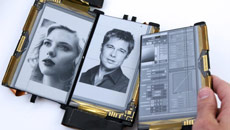
    Named “multi-display shape-changing smartphone”, the 'PaperFold' mobile device uses three flexible electrophoretic (e-ink) display sheets that users can fold into various configurations.  

    Latest in Tech: Fold this smart phone like a map!

    PayPal's Indian-American executive says he quit before Twitter tirade

    PayPal's Indian-American executive says he quit before Twitter tirade
    Rakesh "Rocky" Agrawal, PayPal's Indian-American strategy executive claims he had resigned from the payments giant before he unleashed a late-night Twitter rant against a couple of co-workers Friday.

    PayPal's Indian-American executive says he quit before Twitter tirade

    Microchip that would make your PC work like human brain!

    Microchip that would make your PC work like human brain!
    Distressed at the slow speed of your personal computer? Here comes a microchip that would give your PC a speed that is 9,000 faster than an average one.

    Microchip that would make your PC work like human brain!