Harpreet Kaur Chandi—better known across the world as Polar Preet—does not fit into any box society may have once imagined for her.
Born in Derby, England, to Punjabi immigrant parents, she has gone from a South Asian household where questions about marriage and cultural expectations shaped her girlhood to becoming the first woman of color, and the first South Asian, to ski solo to the South Pole.

She has since gone on to break Guinness World Records, inspire thousands, and prove that boundaries—whether cultural, physical, or emotional—are often only as strong as the belief we give them.
When you picture her in Antarctica, imagine this: a lone figure against an endless horizon of white, pulling a sled heavier than her body weight, skin blistering in temperatures plunging below -50C, with only her breath and her thoughts for company. “When I set out, I wanted to show that people who look like me belong everywhere, even in places we’ve never been seen before,” she says. That mission, born from deeply personal experiences of identity and resilience, has made her story resonate far beyond the ice.
Growing Up Punjabi in Derby
Preet grew up in Derby, the youngest of three children in a Punjabi household. Much of her childhood was shaped by the presence of her Babaji, Karnail Singh, who stepped in as a constant source of love and stability after her parents separated. With his flowing white beard and twinkling blue eyes, she always thought he was the ‘Indian Santa Claus’. For Preet, he wasn’t only her grandfather—he was a safe place, someone who made the world feel gentler no matter what was happening outside their front door.

Her mum, too, played an enormous role in shaping her outlook towards life. Married at 17 and having three children while balancing the expectations of the community was no small task, yet she did it with quiet resilience. Preet remembers watching her work tirelessly, often in the face of unspoken judgments, and drawing strength from her example. Those early lessons in perseverance and dignity would stay with Preet long after.
Still, as a child, Preet often found herself wrestling with belonging as a South Asian in the UK. Blonde dolls lined toy store shelves, and she sometimes wished she had the blue eyes of her school friends. At school, she never quite felt she fit in, and at home, the rules she followed seemed different from those of her peers. It was a delicate balance—between cultures, expectations, and her own sense of self—that she would continue to navigate as she grew older.
At ten, she found tennis. Sport was not common in her world, especially for girls, but it became her outlet. The community raised eyebrows, but Preet’s mum let her play: “She gave me space to do something different.” That encouragement planted seeds of defiance and independence—traits that would one day push her toward some of the harshest landscapes on Earth.
Choosing Her Own Path
As she got older, expectations grew louder. By her late teens, people in her community began asking: “When are you getting married?” Preet, however, envisioned a different path. At 19, she quietly applied to join the British Army. She didn’t tell her family until she’d already signed up.
“It wasn’t a common thing for a Punjabi girl,” she says with a laugh. “But I didn’t want to just follow a script that was written for me.” She went on to join the Army full-time at 27 as a physiotherapist.

Her time with the troops took her across the world: South Sudan, Nepal, Kenya. In South Sudan, she was stationed alongside Indian troops, who invited her for parothe and cricket games on Sundays. “I felt this amazing connection to home thousands of miles away,” she remembers. The Army taught her discipline, resilience, and what it meant to operate under pressure.
Even as she served, she began chasing challenges outside work. She signed up for marathons, ultramarathons, and long-distance races. Her first ultramarathon was, in her own words, “a disaster.” She packed a picnic rucksack, underestimated the distance, and realized she was terribly underprepared. “I got to 50 miles, then slept in the car,” she laughs. But what might have deterred someone else only hooked her deeper.
In 2016, she took on the Marathon des Sables—six marathons across the Sahara Desert in seven days. The searing heat, sandstorms, and exhaustion were brutal, but it planted in her the idea that she could push even further. Antarctica began calling.
The First Expedition: Claiming Space
On January 3, 2022, Preet reached the South Pole after skiing solo for 700 miles over 40 days. She became the first woman of color to achieve this feat. She carried with her audiobooks from South Asian authors—Kal Penn, Anita Rani—voices of home echoing across the stark silence of the ice. Her sled was named “Simran” after her niece. “Every time I looked at it, I thought of her, and I wanted her to know that you can do anything.”
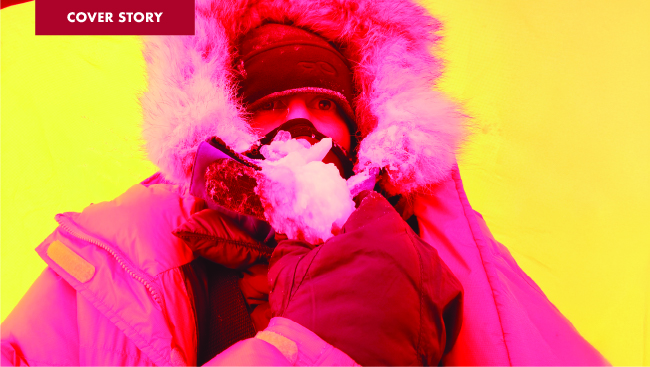
That moment—planting her metaphorical flag in the snow, knowing she had carved a path where none like her had gone before—was both deeply personal and widely symbolic. “Representation matters. Someone told me they’d never seen frostbite on brown skin. I realized that even in medicine, even in exploration, there are gaps that people like me can fill.”
The Second Expedition: Lessons in Failure
Not long after, she set her sights even higher: crossing the entire landmass of Antarctica solo and unsupported. On November 14, 2022, she started her grueling 922-mile attempt that lasted 70 days. She fell short—just 100 miles from her goal. The heartbreak was raw. “I was devastated,” she admits. “I felt like I’d failed. I thought, why did I even come here?”
But with time, she reframed it. “That journey was never just about me. It was about showing others what’s possible. Even though I didn’t make the crossing, I broke two Guinness World Records: the longest solo unsupported one-way polar ski journey for a woman, and the longest overall.”
It came at a cost. She lost weight, battled injuries, and pushed her body to near collapse. Yet the failure taught her what success never could: that changing the goalposts doesn’t diminish the achievement.
The Third Expedition: Speed and Strength
On November 26, 2023, she returned to Antarctica for her third expedition, determined not to let the second define her. This time, she skied from Hercules Inlet to the South Pole—700 miles—in record speed: 31 days, 13 hours, 19 minutes. She set the female speed record, powered not only by strength but by the lessons of failure.
“Every setback gives you something you can use,” she reflects. “That failure made me stronger. Without it, I couldn’t have achieved this.”
Carrying Her Community with Her
Beyond records and expeditions, what makes Polar Preet remarkable is how deeply she ties her story to her roots. She talks openly about feeling “different” growing up, about cultural expectations and pressures. Yet she also speaks with pride about her heritage. Her sled named after Simran, her grandfather’s nickname as Santa Claus, the parothe in South Sudan—these details anchor her global adventures in the warmth of home.
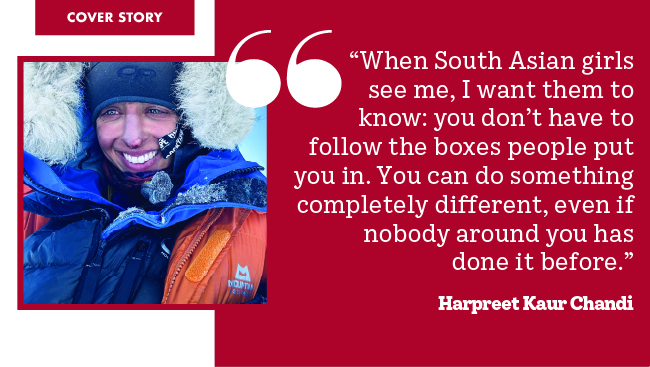
She is acutely aware of what her visibility means. “Being the first is important—but what matters more is making sure I’m not the last,” she says. “When South Asian girls see me, I want them to know: you don’t have to follow the boxes people put you in. You can do something completely different, even if nobody around you has done it before.”
She quotes Rupi Kaur often: “I stand on the sacrifices of a million women before me, thinking what I can do to make this mountain taller so the women after me can see farther.”
Looking Ahead
Preet is far from done. Her Antarctic journeys may have earned her global recognition, but her mission has never been about collecting records—it’s about pushing boundaries, and in doing so, showing others what is possible. Now, she is preparing for her next great challenge: the North Pole. Unlike Antarctica, which rests on solid land and offers 24 hours of daylight during the season, the North Pole sits in the middle of the sea, a constantly shifting landscape of ice. To get there, she will haul sleds across towering ridges, navigate cracks where the ice drifts apart, and even swim through stretches of freezing water in an immersion suit while her sleds float beside her.
“No woman has ever skied solo to the North Pole, and only two men have done it unsupported,” she explains. “My aim is to be the first woman in history.” Nobody has attempted the feat solo in over a decade. It is more difficult, more dangerous, and more expensive than anything she’s done before—but Preet’s resolve is clear.
Her ambition goes beyond the ice. She wants to inspire, to mentor, to remind people—especially young South Asians—that their worth isn’t tied to conformity. She continues to give talks, to share her journey, and to create spaces where others feel brave enough to dream their own big, bold dreams.
At home, she remains grounded. She builds tents in the garden with her niece, Simran, encouraging her curiosity. She speaks proudly of her mum, whose quiet courage gave her the freedom to be bold. And she smiles when she thinks of Derby, of the streets where it all began.
The Legacy of Polar Preet
Harpreet Kaur Chandi’s story is not just about Antarctica. It’s about resilience, representation, and rewriting expectations. It’s about a South Asian woman standing in the most remote, frozen place on Earth and knowing she belongs.
Her journey is proof that breaking barriers begins with believing you can. And as she continues to chase the horizon, she carries with her the voices, hopes, and dreams of a community that sees itself reflected in her courage.
“This journey was always about more than me,” she says. “It was about showing that no matter where you come from, you can go further than you ever imagined.”