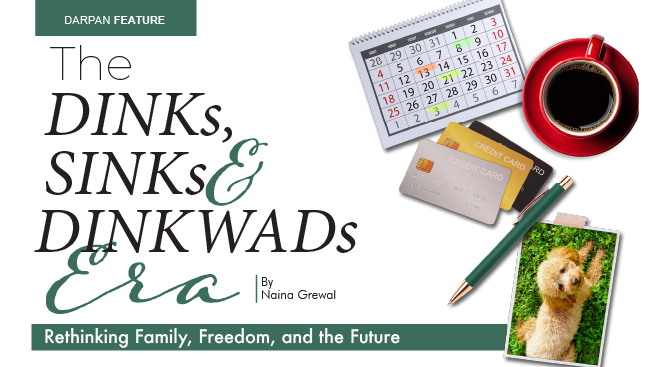
Not long ago, adulthood followed a familiar script: finish school, find a job, get married, buy a home, and have children. Today, that script is being rewritten, with lifestyle labels like DINKs (Dual Income, No Kids), SINKs (Single Income, No Kids), and DINKWADs (Dual Income, No Kids With a Dog) reflecting shifting ideas around family, finances, and fulfillment. For many young adults, the question is no longer when to have children, but whether to have them at all, with others delaying parenthood for career growth, financial stability, travel, or personal development.
Influencer and Women Empowerment Advocate Hemali Mistry, who has been open about being child-free by choice, believes today's generation is rethinking long-held assumptions. "I think people are waking up to what it means to be a good parent and the amount of effort that it takes, especially women," she says. "This is the first time in history where parents are having raw, open, and honest conversations on what parenting takes because social media has given them a platform to share their stories. Once you understand the full mental, financial, and physical cost of having kids, it makes sense why people are either waiting until they're truly ready or opting out altogether."
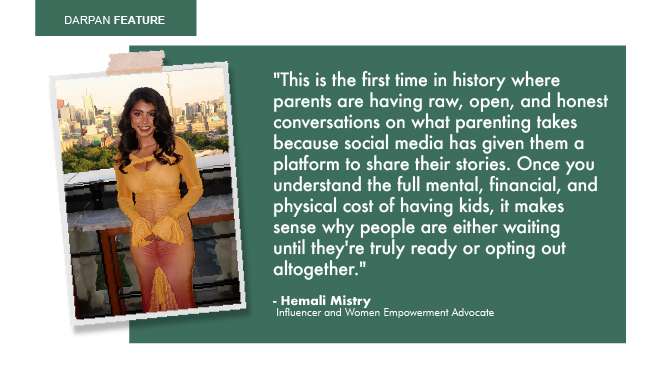
The choice to remain child-free, however, is still met with skepticism, particularly within South Asian communities where marriage and children are often viewed as expected milestones rather than personal decisions. Questions like “Who will take care of you when you're older?” or “Won't you regret it?” remain common. Mistry doesn't shy away from those conversations. "I'd rather regret not having kids than having kids because then at least the regret only affects my life and not the child's," she points out. "I truly believe it takes a village to raise children, and I love being an active member of that village."
She also challenges the notion that choosing not to become a parent is somehow irresponsible: "How is it anyone's inherent responsibility to have kids when having them is a choice? The world is not going to end if I have kids or not." Instead, she argues, fulfillment looks different for everyone. "No one can tell you what fulfills you," she emphasizes. "A fulfilling and meaningful life looks like doing things that make you feel happy."
According to Balraj Singh, RCC and owner of One Heart Wellness Clinic, today's decisions around marriage and parenthood are becoming far more intentional. "There are several factors contributing to this shift," Singh explains. "The rising cost of living, housing affordability challenges, career demands, and a desire for greater personal freedom all play a role." That said, beyond economics, he sees a generation that's willing to pause. "Rather than following traditional timelines, people are asking themselves what genuinely aligns with their values, goals, and circumstances."
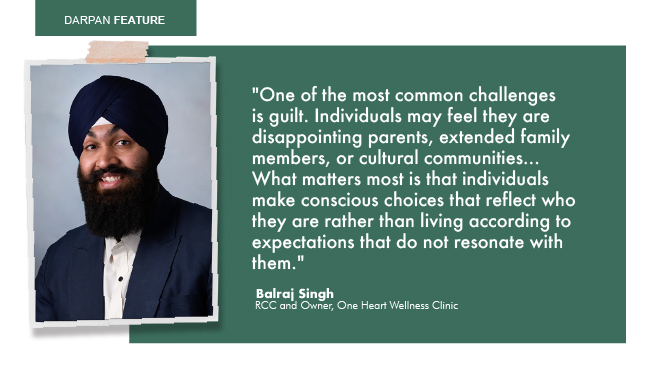
Of course, that self-reflection often comes with emotional challenges, especially when personal choices clash with family expectations. "One of the most common challenges is guilt," Singh reveals. "Individuals may feel they are disappointing parents, extended family members, or cultural communities." For many South Asians, the pressure is not necessarily explicit, but deeply embedded in culture and family traditions. Singh admits clients frequently wrestle with balancing respect for those traditions while remaining authentic to themselves.
"The conversation is often less about rejecting family life and more about creating a life that feels authentic and sustainable." He believes the discussion shouldn't be framed as choosing one lifestyle over another. "There is no single definition of fulfillment," he outlines. "What matters most is that individuals make conscious choices that reflect who they are rather than living according to expectations that do not resonate with them."
The idea of conscious decision-making is central to Emotional Wellness Coach and Hypnotherapist Shelly Kaur. She challenges one of society’s most persistent assumptions, that children guarantee happiness or security later in life. “It is a myth that only children can bring happiness,” she warns. Shelly points to research suggesting that long-term life satisfaction is shaped more by physical health, financial stability, social connection, purpose, and community engagement.
While many parents find meaning in raising children, she adds there is no evidence that having children guarantees happiness, just as remaining child-free does not necessarily lead to loneliness. Kaur also highlights changing family dynamics, where adult children may live far away, face their own financial and emotional pressures, and may not always be able to provide expected support.
Kaur also shines the spotlight on newer discourse on the ethics of having children: “Modern ethical discussions increasingly ask whether creating a new life carries moral responsibilities from a spiritual standpoint.” Through deeper reflection, she connects broader questions about suffering, poverty, and war back to the idea of birth itself, suggesting that existence inevitably carries pain and loss. This leads to the perspective that some younger adults are rethinking parenthood by weighing not just personal readiness, but also the ethical implications of bringing a child into the world.

“The real goal is not approval from society, but alignment with one’s own truth,” Kaur asserts. A meaningful life can come through relationships, creativity, community service, spirituality, travel, career achievements, and finding one’s own calling. She also notes that a society valuing freedom should respect both those who choose parenthood and those who do not, while encouraging more conscious reflection around life-altering decisions like having children.
Perhaps the biggest takeaway from today’s growing list of lifestyle labels is that modern life no longer follows a single blueprint. DINKs, SINKs, and DINKWADs are less about categories and more about shifting definitions of family and fulfillment. No path is less or more valid than the other. The key is having the freedom to define family, purpose, and fulfillment for oneself.