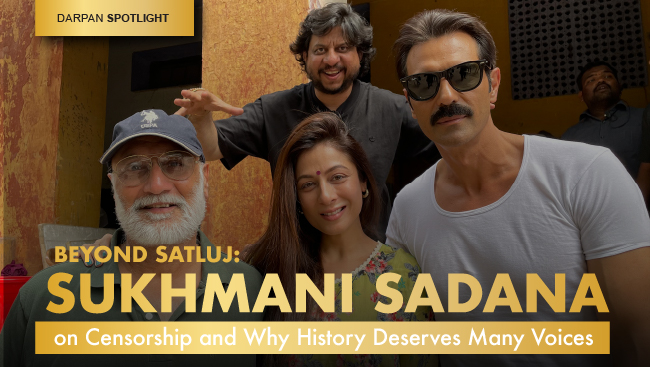
The conversation around Satluj has grown far beyond the film itself. Inspired by the life of human rights activist Jaswant Singh Khalra, the Honey Trehan-directed film—headlined by Diljit Dosanjh—was briefly available on ZEE5 before being removed following government action under the Information Technology Act. As debates around censorship, artistic freedom, and historical storytelling continue, actor and screenwriter Sukhmani Sadana, who plays a television journalist in the film, reflects on the responsibilities of storytellers, the changing role of journalism, and why history should never be reduced to a single perspective.
Q1. Satluj has become part of a much larger conversation about censorship than cinema itself. Where do you think the line should be drawn between protecting public interest and protecting artistic freedom?
Sukhmani Sadana: Storytelling comes with responsibility for everyone involved - the writer, director, producer, and actors. When films are based on real events, they should be made by people who approach the subject with honesty rather than the intention of provoking controversy. In Satluj, Honey Trehan presents history through a straightforward narrative without asking the audience what to think. Cinema should allow different perspectives to exist. If someone wishes to tell another side of the story, they should have the freedom to do that too. Audiences today are thoughtful enough to engage with different viewpoints and form their own opinions.
Q2. You portray a fearless journalist in the film. Has journalism changed, or is courage still its defining quality?
Sukhmani Sadana: Courage remains the foundation of journalism. The challenges may look different today, but there are still journalists asking difficult questions and standing by their principles. At the same time, I do feel earlier generations displayed an extraordinary fearlessness despite having just as much to lose. That spirit continues to inspire me, and it was one of the reasons I connected so deeply with my character.
Q3. Do controversies like this discourage filmmakers from telling politically or historically sensitive stories?
Sukhmani Sadana: I don't think this changes the mindset of storytellers. There have always been filmmakers who choose to explore difficult subjects, just as there have always been those who prefer commercial cinema. Films dealing with complex history have existed for decades. Ultimately, it comes down to the kind of stories a filmmaker believes in telling.
Q4. Has the controversy changed how people will remember Satluj?
Sukhmani Sadana: I think the film would have found its audience regardless, because of the subject it explores. However, the controversy has undeniably created curiosity. Many people who may never have watched the film are now asking why it was restricted. In that sense, the conversation has become much bigger than the film itself. Attempts to suppress a story can sometimes make more people want to understand it.
Q5. If a young journalist or filmmaker approached you today wanting to tell a difficult story rooted in history, but was worried, what would you tell them?
Sukhmani Sadana: Tell the story you believe in but remember that storytelling carries immense responsibility. Your work should contribute to understanding rather than deepening divisions. Present the subject honestly, acknowledge different perspectives where appropriate, and trust the audience to think for themselves. Most importantly, don't be afraid to tell meaningful stories, but never misuse the power that comes with telling them.