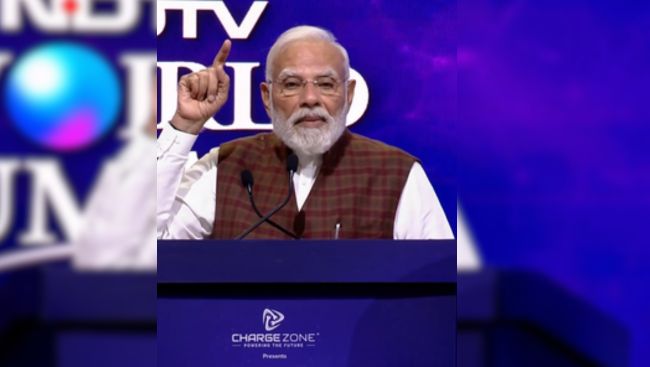
Prime Minister Narendra Modi delivered the keynote address at the NDTV World Summit 2025 held at New Delhi on Friday.
Welcoming the distinguished gathering of global leaders, the Prime Minister set the tone for the summit. In his speech, PM Modi emphasised India’s unwavering momentum and its role as a beacon of hope in a rapidly evolving world.
Extending Diwali greetings to all citizens, PM Modi noted that the NDTV World Summit is being held in the midst of the festive atmosphere. He appreciated the theme of the session—“Unstoppable India”—and remarked that it is indeed apt, as India today is in no mood to stop. The Prime Minister affirmed, “India will neither stop nor pause, 140 crore Indians are moving forward rapidly, together”.
Prime Minister observed that in a world facing diverse roadblocks and speed breakers, the discourse around an “Unstoppable India” is both natural and timely. He sought to place this theme in the context of the situation eleven years ago and the present.
Recalling the pre-2014 era, PM Modi highlighted the nature of discussions that dominated such summits at the time. He pointed to concerns such as how India would withstand global headwinds, how it would exit the “Fragile Five” grouping, how long the nation would remain trapped in policy paralysis, and when the era of large-scale scams would come to an end.
Recalling that prior to 2014, concerns over women’s safety were widespread, and revelations about the unchecked spread of terrorist sleeper cells dominated discourse, PM Modi noted that songs lamenting inflation, such as “Mehangai Dayan Khaye Jaat Hai,” were commonly heard.
At that time, both citizens and the global community felt that India, entangled in a web of crises, would not be able to emerge. The Prime Minister asserted that over the past eleven years, India has shattered every doubt and overcome every challenge. He highlighted that India has transitioned from being part of the “Fragile Five” to becoming one of the top five global economies. Inflation is now below two per cent, while the growth rate exceeds seven per cent.
“From chips to ships, the confidence of an Atmanirbhar Bharat is evident across sectors”, highlighted the Prime Minister, emphasising that India no longer remains silent after terrorist attacks; instead, it responds decisively through surgical strikes, air strikes, and operations like Sindoor.
PM Modi urged the audience to recall the COVID-19 period, when the world was living under the shadow of life and death. He noted that global speculation was rife about how a country with such a large population would survive such a massive crisis.
The Prime Minister stated that India proved every speculation wrong. He highlighted that India confronted the crisis head-on, developed its own vaccines swiftly, administered them in record time, and emerged from the crisis as the fastest-growing major economy.
Prime Minister stated that even before the impact of COVID-19 had fully subsided, conflicts began emerging across various parts of the world, with headlines dominated by news of war. He noted that once again, questions were raised about India’s growth prospects.
PM Modi affirmed that India once again disproved all speculations and continued to advance as the fastest-growing major economy. Over the past three years, India’s average growth rate has stood at an unprecedented and unexpected 7.8 per cent. He informed that the merchandise export data released two days ago shows a nearly 7 per cent increase compared to the previous year.
Last year, India achieved agricultural exports worth approximately ₹4.5 lakh crore. Amidst unstable ratings in many countries, S&P upgraded India’s credit rating after 17 years. The IMF too has revised India’s growth outlook upward.
The Prime Minister highlighted that just a few days ago, Google announced a major investment of $15 billion in India’s AI sector. He added that significant investments are also being made in green energy and semiconductor sectors.
“India’s growth today is shaping global opportunities”, exclaimed PM Modi citing the recent EFTA Trade Agreement as a major example, under which European nations have committed investments worth $100 billion in India.
This, he noted, will lead to large-scale job creation. Referring to the recent visit of the Prime Minister of the United Kingdom and his close friend, H.E. Mr. Keir Starmer, who arrived with the largest-ever business delegation, PM Modi remarked that this reflects the scale of opportunities the world sees in India. He highlighted that India’s trade with G-7 countries has increased by over sixty per cent.
“The world now views India as a reliable, responsible, and resilient partner”, affirmed PM Modi, stating that from electronics to pharmaceuticals, and from automobiles to mobile manufacturing, a wave of investment is flowing into India. He emphasised that these investments are helping India become a nerve centre of the global supply chain.
Noting that a topic of discourse in the summit, “Edge of the Unknown,” may represent uncertainty for the world, but for India, it is a gateway to opportunity, PM Modi emphasised that India has, for centuries, shown the courage to tread unknown paths. Saints, scientists, and navigators have consistently demonstrated that the “first step” marks the beginning of transformation.
Whether in technology, vaccine development during the pandemic, skilled manpower, fintech, or the green energy sector, India has converted every risk into reform, every reform into resilience, and every resilience into revolution. The Prime Minister cited the recent remarks of the IMF Chief, who expressed great enthusiasm about the boldness of India’s reforms.
He shared an example where global consensus doubted the feasibility of delivering digital identity at a mass scale, yet India proved them wrong. Today, fifty per cent of the world’s real-time digital transactions occur in India, and India’s UPI is dominating global digital payment systems.
PM Modi underlined that outperforming every prediction and assessment has become India’s defining trait—and that is why India is unstoppable.
“The true strength behind India’s achievements comes from its people”, emphasised PM Modi, stating that citizens can fully realise their potential only when the government does not exert pressure or interfere in their lives. He remarked that excessive government control acts as a brake, while greater democratisation accelerates progress.
The Prime Minister criticised the opposition party, which governed for sixty years, for consistently promoting the bureaucratisation of policy and process. In contrast, he highlighted that over the past eleven years, his government has focused on democratising both policy and process—an important factor behind the rise of an unstoppable India.
Citing the banking sector as an example, the Prime Minister recalled that in the 1960s, the then Prime Minister had justified the nationalisation of banks by claiming it would extend banking services to the poor, farmers, and labourers. However, he asserted that in reality, the then-ruling party distanced banks from the people to the extent that the poor feared even approaching bank doors.
As a result, the Prime Minister said, in 2014, more than half of India’s population did not have a bank account. PM Modi clarified that this was not merely a lack of bank accounts—it meant that a large segment of the population was deprived of banking benefits and forced to borrow at high interest rates from the market, often pledging their homes and land.
Underlining that it was imperative to free the country from excessive bureaucratisation, and their government has successfully achieved this, the Prime Minister highlighted the democratisation and reform of the banking sector, including the opening of over 50 crore Jan Dhan accounts in mission mode. Today, every village in India has at least one banking touchpoint.
PM Modi remarked that digital transactions have made India one of the most financially inclusive nations globally. He criticised the opposition-led nationalisation for creating a mountain of NPAs in banks and remarked that his government’s efforts of democratisation have brought banks to record profitability. Over the past eleven years, loans worth lakhs of crores have been extended without bank guarantees to women self-help groups, small farmers, livestock rearers, fishermen, street vendors, and Vishwakarma partners.
Prime Minister cited the petroleum and gas sector as another example of transformation. He recalled that prior to 2014, under the prevailing mindset of bureaucratisation, the opposition government was preparing to shut petrol pumps from 8 PM to 8 AM to avoid increasing fuel subsidies.
In contrast, he highlighted the present scenario where petrol pumps operate round the clock without restrictions. The Prime Minister emphasised that India is now making unprecedented investments in alternative fuels and electric mobility.
Highlighting that during the opposition era, even obtaining a gas connection required recommendation letters from Members of Parliament, PM Modi reflected the extent of bureaucratisation in the system. In contrast, he stated that his government provided free gas connections to over 10 crore poor families—many of whom had never imagined access to such a facility. He affirmed that this is what true democratisation of governance looks like.
Prime Minister remarked that during the era dominated by bureaucratic thinking, the opposition allowed public sector undertakings (PSUs) to stagnate, metaphorically locking them up and resting easy. He criticised the mindset that questioned the need for effort, assuming it bore no personal cost. The Prime Minister affirmed that his government changed this approach. Today, major PSUs such as LIC and SBI are setting new records in profitability.
Prime Minister emphasised that when government policies are rooted in democratisation rather than bureaucratisation, the morale of citizens rises. He criticised the opposition party for repeatedly chanting “Garibi Hatao” without delivering results, asserting that poverty did not decline under their governance. In contrast, he highlighted that his government’s democratized approach has lifted 25 crore poor citizens out of poverty over the past eleven years. This, he said, is why the nation places its trust in the current government and why India is unstoppable today.
PM Modi affirmed that India now has a government dedicated to serving the poor and the deprived, giving priority to backward communities and working with full sensitivity to improve their lives. He noted that such efforts often go unnoticed in major discussions.
As an example, he cited the recent launch of BSNL’s Made-in-India 4G stack, calling it a significant national achievement. He proudly stated that India is now among the top five countries globally with an indigenously developed 4G stack. The Prime Minister pointed out that BSNL, a public sector company once neglected by the opposition, is now achieving new milestones. He added that the launch of the 4G stack was accompanied by BSNL activating nearly one lakh 4G mobile towers on the same day.
As a result, millions of people living in remote forests and hilly regions—areas previously untouched by high-speed internet—are now receiving fast internet services.
Sharing a striking third dimension of India’s success that often goes unnoticed, PM Modi emphasised that when advanced facilities reach remote regions, they transform lives. Citing the example of e-Sanjeevani, the Prime Minister illustrated how a family living in a distant hilly area, unable to take a sick member to the doctor due to bad weather, can now access medical consultation through the high-speed connectivity-based e-Sanjeevani service.
Explaining further, PM Modi said that through the e-Sanjeevani app, patients in remote areas can connect with specialist doctors directly from their phones. He informed that over 42 crore OPD consultations have already been facilitated via e-Sanjeevani.
On this very day of his address, PM Modi said that more than one lakh people across the country had received assistance through the platform. The Prime Minister emphasised that e-Sanjeevani is not merely a service—it is a symbol of trust that help will be available in times of crisis. He described it as a powerful example of the transformative impact of democratising public systems.
PM Modi underscored that a sensitive government, committed to democracy and the Constitution, makes decisions and formulates policies that prioritise ease of living and financial savings for citizens.
He highlighted that prior to 2014, 1 GB of data cost ₹300, whereas now it costs only ₹10, resulting in annual savings of thousands of rupees for every Indian. Through the Ayushman Bharat scheme, the Prime Minister noted that poor patients have saved ₹1.25 lakh crore. Medicines at PM Jan Aushadhi Kendras are available at 80 per cent discount, leading to savings of approximately ₹40,000 crore. Additionally, reduced prices of heart stents have enabled annual savings of ₹12,000 crore for poor and middle-class families.
Emphasising that honest taxpayers have directly benefited from his government’s reforms, the Prime Minister highlighted significant reductions in both income tax and GST, noting that this year, income up to ₹12 lakh has been made tax-free.
He mentioned that the GST Bachat Utsav is currently in full swing, and recent sales have broken all previous records. The Prime Minister affirmed that these measures—on income tax and GST—are set to yield annual savings of approximately ₹2.5 lakh crore for Indian citizens.
PM Modi acknowledged the widespread national and international appreciation for Operation Sindoor. He then shifted focus to another critical issue—Naxalism and Maoist terrorism—which he described as not only a major security concern but also deeply linked to the future of India’s youth.
He stated that during opposition rule, the ecosystem of Urban Naxals had become so dominant that the rest of the country remained unaware of the extent of Maoist terrorism. While terrorism and Article 370 were widely debated, PM Modi said that Urban Naxals occupied key institutions and actively worked to suppress discourse on Maoist violence. He noted that even recently, several victims of Maoist terrorism came to Delhi, yet the opposition ecosystem ensured that their plight received little attention.
The Prime Minister described the grave situation that once prevailed across nearly every major state in India, where Naxalite and Maoist violence had taken deep root. He stated that while the Constitution was in force across the country, in the Red Corridor, there was no one to even invoke its name. Governments were elected, but in those regions, they held no real authority. The Prime Minister recounted how, after dusk, stepping outside became perilous, and even those responsible for providing security to the public had to move under protection themselves.
Highlighting the devastating impact of Maoist terrorism over the past 50–55 years, stating that thousands of lives were lost, including many security personnel and young citizens, PM Modi emphasised that Naxalites obstructed the construction of schools and hospitals, and even bombed existing facilities. As a result, a vast region of the country and a large segment of the population remained deprived of development for decades.
PM Modi underscored that this prolonged neglect disproportionately affected tribal communities and Dalit brothers and sisters, who bore the brunt of this violence and underdevelopment.
“Maoist terrorism is a great injustice and a grave sin against the nation's youth”, remarked the Prime Minister, affirming that he could not allow young citizens to remain trapped in such circumstances.
Therefore, since 2014, his government has worked with full sensitivity to reintegrate misguided youth into the mainstream. The Prime Minister highlighted the results of these efforts: while 11 years ago, over 125 districts were affected by Maoist violence, today that number has reduced to just 11 districts. Of these, only three remain highly Naxal-affected.
PM Modi stated that over the past decade, thousands of Naxalites have surrendered, sharing a recent statistic from the last 75 hours, during which 303 Naxalites laid down arms and surrendered. He added that these were not ordinary insurgents—some carried bounties of ₹1 crore, ₹15 lakh, or ₹5 lakh, and a large cache of weapons was also recovered from them.
The Prime Minister affirmed that these individuals are now returning to the mainstream of development and openly acknowledging that they were on the wrong path. He emphasised that they now move forward with faith in the Constitution of India.
Reflecting on how headlines once routinely reported incidents from Bastar, Chhattisgarh—then known as a stronghold of Naxalism- the Prime Minister highlighted the transformation, noting that today, tribal youth in Bastar are organising the Bastar Olympics, a symbol of peace and progress.
He stated that this Diwali, regions freed from Maoist terrorism will celebrate with renewed joy, lighting lamps of happiness. PM Modi assured the people of India that the day is not far when India will be completely free from Naxalism and Maoist violence, adding that it's a guarantee of their government.
“India’s journey toward becoming a developed nation is not merely a pursuit of growth; Development must walk hand in hand with dignity, where speed is matched by respect for citizens, and innovation must aim not only for efficiency but also for empathy and compassion. India is progressing with this very mindset”, remarked the Prime Minister. He concluded by acknowledging the significant role of platforms like the NDTV World Summit in advancing this vision and expressed gratitude for the opportunity to present the nation’s perspective, and extended his best wishes to all participants of the event.
Picture Courtesy: IANS