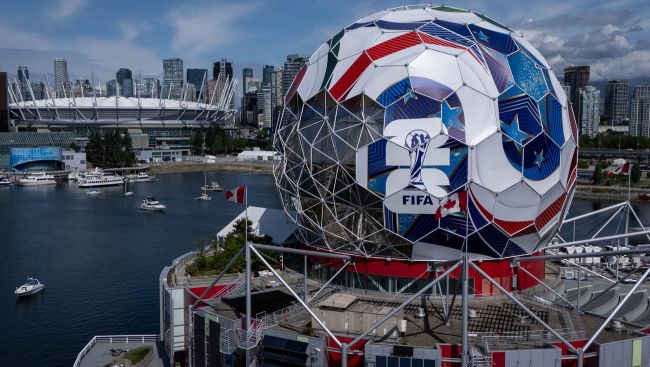
The British Columbia government says the cost of hosting World Cup matches in Vancouver has spiked again and could reach $729 million, almost triple what the province estimated in 2022.
And while the province says net hosting costs could go down by more than $30 million compared with 2025 projections, that is largely due to the new inclusion of $100 million in federal security funding from Public Safety Canada as a form of revenue — despite it being publicly funded.
"This is going to be a contribution from all taxpayers," B.C. Sports Minister Anne Kang said of federal contributions, which also include $116 million from Sport Canada that was in previous June 2025 estimates.
With the first match of seven at BC Place just a few weeks away, the province released a new range of total costs on Friday, from $685 million to $729 million, up from $532 million to $624 million last June.
That means the midpoint estimate is up by $129 million, or 22.3 per cent.
The province says in a briefing document that there were "still many unknowns" when the last estimates were issued almost a year ago, including which countries would play in Vancouver and "evolving FIFA requirements."
The City of Vancouver and public sector service providers would cover more than half of the total costs, with the rest coming from Crown-owned stadium company PavCo and the province, the document says, although that assertion omits the federal funding.
Provincial officials say World Cup costs will be offset by up to $615 million in revenue and contributions, which could bring net costs down to between $90 million and $114 million.
Kang said the province plans to recoup costs mainly from the hotel tax. Introduced by the provincial government in 2023, the 2.5 per cent tax is paid by travellers who stay in Vancouver's hotels and is expected to stay in place until 2030.
"In the next seven years we'll be able to see $250 million to $260 million revenue from tourists that are staying in Vancouver," Kang said, adding that the province also expects a significant source of revenue to come from BC Place Stadium during the World Cup period.
Jobs Minister Ravi Kahlon, who joined Kang for the unveiling of the estimates in Vancouver on Friday, said the province expects around $1 billion in additional GDP for B.C.'s economy over the next five years because of an expected increase in out-of-province visitors.
Kahlon said the government's projection is based on economic modelling of past large scale events such as last year's Invictus Games and a series of Taylor Swift concerts in 2024.
"The modelling is based off that. And it's also two years of already collecting the hotel tax that gives us a pretty clear indication of what we can project for the revenue that we want to see in the province," Kahlon said.
Last week, the British Columbia Hotel Association said June hotel occupancy rates were down compared with last year, and the World Cup wasn't generating the demand many expected.
But Kahlon said hotel bookings have gone up over the past week, with more expected as World Cup teams advance through the group stage.
The range of total costs includes everything B.C. and Vancouver will spend to plan and host the event, such as stadium upgrades, fan festivals, traffic and security.
A government official said in a background briefing that the highest projected cost went up by $105 million compared with last year's estimate mostly because of security and the FIFA Fan Festival.
Security expenses for B.C. and Vancouver are estimated at $242 million, which are expected to be offset by the $100 million contribution from Public Safety Canada.
Kang would not provide specific information related to policing costs, citing security reasons.
Vancouver will host seven games starting on June 13, while Toronto will host six, kicking off with Canada's first match on June 12.
The briefing document provided by the B.C. government on Friday emphasizes the projected increases in revenues and cost recoveries.
"Our higher-end estimates of the net core and essential hosting costs have gone down from $145 million in 2025, to $114 million today," it says.
A final total for B.C.'s World Cup costs isn't expected until spring of 2027.
In 2022, the province predicted costs could reach $240 million to $260 million. But the estimates have progressively increased.
Toronto has said it intends to spend $380 million on city-level hosting costs, while an estimate by the federal parliamentary budget officer last week that was partly based on B.C.'s 2025 projections said Canada would spend a total of $1.066 billion, including federal costs of $473 million.
Picture Courtesy: THE CANADIAN PRESS/Ethan Cairns