
Friday, May 22, 2026
ADVT 
National

Canada won't 'leverage' energy, critical minerals in trade talks: PM

Darpan News Desk The Canadian Press, 01 May, 2026 02:13 PM
  • Canada won't 'leverage' energy, critical minerals in trade talks: PM

Prime Minister Mark Carney says Canada will not use energy or critical minerals as “leverage” in upcoming trade talks with U.S. President Donald Trump’s administration.

But Carney suggested further integration with the United States in those sectors — highly coveted by the Trump administration — remains in question.

“I reject that characterization of it’s leverage. It's looking at, is it in our mutual interest to trade more. Where is it? And if it's not there, we have other options,” Carney said Friday in his first interview with The Canadian Press since entering federal politics.

"Should we be further integrating our energy markets with the United States at a time they view that as, quote, 'leverage'?"

Carney's comments come as his government grapples with damaging U.S. tariffs that remain locked in place as a scheduled review of the continental free trade pact approaches.

Carney pointed to the plight of Canada’s “incredibly” integrated automobile market, which he said is at risk of being “pulled apart” by U.S. tariffs.

On Wednesday, United States Trade Representative Jamieson Greer told a group of visiting Canadian politicians, trade envoys and businesspeople in Washington that Canada should not attempt to use its energy and natural resources as leverage in negotiations on the continental free-trade pact.

Greer said the administration is looking to work with Canada on energy and critical minerals development in ways that would benefit both countries.

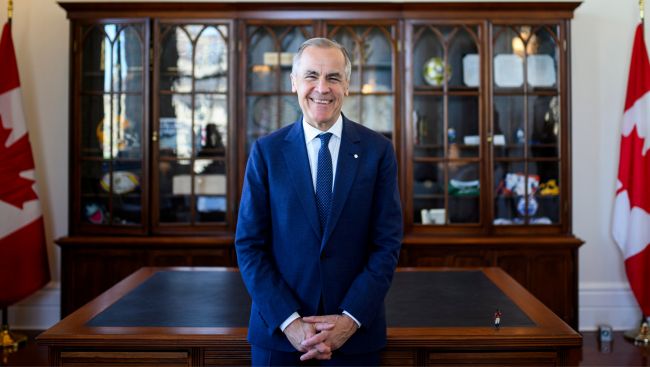
Carney spoke with The Canadian Press in his office on Parliament Hill, now decorated with sports paraphernalia — an Edmonton CFL helmet and football, various items of Oilers swag. The office has changed noticeably since the departure of his predecessor Justin Trudeau, who was less of a sports fanatic and more of a sci-fi buff — though did have a Habs jersey on display.

Carney granted a rare series of interviews to journalists this week, including CBC News and the French-language newspaper La Presse, to mark the one-year anniversary of his electoral victory last year and highlight some of his accomplishments.

He talked up a marked improvement in federal-provincial relations over the past year and the creation of new federal offices to speed up industrial project approvals and major government purchases for the military.

Carney also defended Trudeau’s record on trade and his handling of Trump. He credited Trudeau with successfully negotiating the CUSMA agreement during Trump’s first term in the White House.

The Canadian Press asked Carney if he understands Trump and his notions about the “art of the deal” better than Trudeau did, given the stark change in the tone of the relationship with the U.S. president that happened when Carney succeeded Trudeau.

Carney said he’s learned over the past year that Trump prefers being spoken to directly but respectfully, and abhors statements cloaked in “flattering language.”

Carney said that CUSMA “stands the test of time” and added he believes most of the trade pact will survive its upcoming renewal.

“Much of it will be retained. Some things are going to have to change, but we're looking to make sure they change in a way that's in Canada's interest,” he said.

Picture Courtesy: THE CANADIAN PRESS/Spencer Colby

MORE National ARTICLES

'All bets are off': B.C. pulls liquor, changes procurement after U.S. tariffs

'All bets are off': B.C. pulls liquor, changes procurement after U.S. tariffs
British Columbia Premier David Eby says the province and the country is strong enough to weather the storm in the threat to Canada's sovereignty coming from a former friend. Eby took the unusual step of interrupting B.C.'s budget lockup to address how the province will respond after U.S. President Donald Trump imposed tariffs on Canadian goods.

'All bets are off': B.C. pulls liquor, changes procurement after U.S. tariffs

B.C. budget to buffer province against Trump's 'uncertainty and disorder': minister

B.C. budget to buffer province against Trump's 'uncertainty and disorder': minister
Brenda Bailey's budget is being handed down on the same day that Trump says a 25 per cent U.S. tariff will be placed on Canadian goods, while Canadian energy will face 10 per cent tariffs. Bailey says Trump's tariffs came "completely out of nowhere" when he announced them last November and they've already changed B.C.'s financial circumstances.

B.C. budget to buffer province against Trump's 'uncertainty and disorder': minister

Poilievre says Canadian counter-tariffs should go to fund tax cuts

Poilievre says Canadian counter-tariffs should go to fund tax cuts
Conservative Leader Pierre Poilievre says Canada needs to retaliate against American tariffs by targeting U.S. goods Canada can make, does not need or can obtain elsewhere. Poilievre says Canada needs to cut taxes to counteract the domestic impact of tariffs and points to the carbon price, the capital gains tax and income tax.

Poilievre says Canadian counter-tariffs should go to fund tax cuts

Canadians say they will stop buying U.S. products as Trump’s tariffs take effect

Canadians say they will stop buying U.S. products as Trump’s tariffs take effect
Canadians say they are ready to use their wallets to fight the trade war with the United States, which began today as President Donald Trump imposed 25 per cent tariffs on Canadian goods. Haligonians interviewed today said they are focused on buying Canadian whenever possible, and many said they had already stopped purchasing American products, as Trump had been threatening tariffs for months.

Canadians say they will stop buying U.S. products as Trump’s tariffs take effect

How Canadians are reacting to Donald Trump's tariffs

How Canadians are reacting to Donald Trump's tariffs
Canada is immediately imposing 25 per cent retaliatory tariffs on $30 billion worth of American products, and will expand that to cover another $125 billion in U.S. goods in 21 days. Here’s how political, business and union leaders reacted Tuesday.

How Canadians are reacting to Donald Trump's tariffs

The trade war is on between Canada and the U.S. Here's what you need to know

The trade war is on between Canada and the U.S. Here's what you need to know
A trade war between Canada and its largest trading partner has begun, with tariffs imposed by U.S. President Donald Trump now in effect and Prime Minister Justin Trudeau responding with a package of retaliatory tariffs. Stocks are tumbling, businesses are warning of impending layoffs and further measures from both countries are likely in the coming days.

The trade war is on between Canada and the U.S. Here's what you need to know