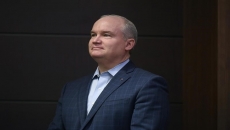
VICTORIA - The British Columbia government is working to resolve legal disputes with First Nations outside of the courtroom to avoid "deepening divisions," Attorney General David Eby said.
The province announced the development of "a new approach to litigation" on Thursday as part of its process to implement its 2019 legislation adopting the United Nations Declaration on the Rights of Indigenous Peoples.
The Attorney General's Ministry said the goals of a series of 20 directives for the Crown are prioritizing resolution and negotiated settlement and reducing the potential for legal action over Indigenous rights and title.
Eby said it's important to respect that First Nations may choose to go through the courts, while at the same time recognizing litigation is an adversarial process that can drive the two sides further apart rather than advance reconciliation.
"These guidelines are really entirely about the civil litigation process; to make it more efficient, to make it less conflict-centric and to really narrow down the issues," he said after a news conference about the opening of a complex care facility in Surrey for those with health, addictions and housing needs.
Eby said the goal is to respect the choices First Nations make to either go to court or avoid it with binding agreements.
"And when we do go to court to have a matter resolved between us, but we do it in a way that's respectful that is, that doesn't deepen divisions."
The first directive for Crown counsel in civil litigation is that they must understand and apply the principles of B.C.'s 2019 law that requires the province to align its laws with the United Nations declaration on Indigenous rights, the ministry said in a statement.
For ongoing litigation that began before the passage of the Declaration Act, the directive says counsel must review their pleadings, legal positions and litigation strategy to ensure that they are consistent with the act.
The ministry says counsel must work with the Indigenous Relations Ministry and "take steps to resolve any inconsistencies, including amending pleadings."
In circumstances where it appears impossible to resolve an inconsistency, the directive says counsel must consult with the attorney general.
Another directive says counsel should "vigorously pursue" alternative forms of resolution throughout litigation, and their main goal is to use the courts as a last resort, "in the narrowest and most constructive way possible."
During an unrelated news conference, Premier John Horgan said the guidelines won't eliminate the need for court altogether.
"At times in a free society, disagreements come up, and the court system has been a place where people go to solve disputes, differences of opinion," he said. "We want to reduce that."
Lydia Hwitsum, the chief of Cowichan Tribes, said all such implements need to be used.
"I think this is one more tool where we can start to move away from the denial of the existence of Indigenous People's humanity, and rights and title."
Terry Teegee, regional chief of the B.C. Assembly of First Nations, said the province is "doing the right thing to push to change the legal culture of fighting and denying (Indigenous) rights."
The directives "may not change the system overnight," but they're a welcome and overdue step, he said in a statement released by the province.
Mary Ellen Turpel-Lafond, a retired judge and law professor at the University of B.C., said that in the past, relationships were "poisoned" by "endless procedural and technical motions and a blanket denial of rights."
The litigation directives will bring "necessary shifts in the mindset and approach of lawyers" acting on the province's behalf, she said in the statement.