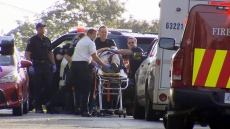
TORONTO - The warning signalling a mass casualty situation blares out from the overhead speakers in the emergency department at St. Michael's Hospital minutes before the first patient shuffles in with painted-on scrapes and bruises talking about an explosion.
Staff at the downtown Toronto facility hear the declaration of a "code orange" and whir into action — they know it's a simulation designed to test the hospital's response to catastrophe but their reaction to the situation is real.
On this recent weekday morning, at 9:49 a.m., they learn a "bomb" has exploded at Union Station, a key transit hub. The first casualty — a volunteer actor — appears five minutes later.
Carolyn Snider, chief of the emergency department, stands at triage near the department's front doors. It's the same spot she stood when the hospital declared a real code orange after a shooting at the Toronto Raptors championship parade in June that left four with bullet wounds and others with injuries from a resulting stampede.
The hospital, Snider says, is carrying out the latest exercise in preparation for the next mass shooting, attack or disaster.
"Sadly, it's a when, not if," she says. "Given the current climate, we have to assume there will be a when. If there was no next time, that would be absolutely, truly wonderful."
St. Michael's is one of two places in Toronto where patients go when trauma hits on a large scale, the other is Sunnybrook Hospital in the city's north. Children are sent to the Hospital for Sick Children.
The emergency department has prepared for the latest simulation for a year. During that time, it has dealt with two real-life code oranges — a shooting rampage that killed two and injured 13 in Toronto's Greektown last summer, and the Raptors parade shooting.
The team learned from the parade shooting that patient identification is key. They're testing improved procedures in this drill.
"You have to have a way to identify to everyone who's coming in," Snider says. "You have that one chance to get it right."
A triage nurse waits at the front door with four boxes of coloured bracelets beside her as patients arrive —green for the walking wounded, red for those who need immediate intervention, yellow for everything in between, and blue for the dead or someone with no vital signs.
"The general principles in a mass casualty incident when your resources are sparse (are that) you should spend very little time trying to resuscitate somebody whose vital signs are absent because they're extremely unlikely to survive," says Rachel Poley, an emergency physician who was among those leading the simulation.
The first patient in the simulation gets a green bracelet, kicking off the test of the new identification system.
A few minutes later, a red bracelet is issued. That patient is a high-tech mannequin missing its lower left leg. Blood spews from the dummy's limb as it is wheeled into the nearby trauma bay.
Doctors and nurses converge and for a while, everything works fine. But that changes within minutes as more and more patients arrive.
At one point a man named Kyle Weir, who works security at the hospital and has been present at two real code oranges, enters with a massive fake head wound and instructions to be "agitated and combatitive." He plays the part and four security guards are needed to hold him down.
In the trauma bay, a second badly wounded mannequin is brought in. Lilly Jenkins, a surgeon leading the trauma team, calls for another nurse.
"No more nurses!" someone shouts.
"Call for another," Jenkins says.
"The phone's not working," another person says as he looks at the portable phone in his hand. He picks up the phone on the wall, which works just fine.
Staff also initiate a numbering system — each patient gets a number that stays with them for the duration of the code orange.
It's something the hospital tried during the response to the Raptors parade shooting. But they implemented it only once the staff became overwhelmed, whereas this time it is used from the start.
In total, 36 patients come through the doors in 37 minutes over the course of the simulation. One died and another went into cardiac arrest, but was rescuscitated and survived.
After the event, staffers are asked for honest evaluations during a 10-minute debrief.
Brian Steinhart, an emergency physician, has a few complaints, including being short on doctors right away. He suggests moving a physician stationed at triage to help treat patients.
He also complains about the hospital phone system, saying staff had to resort to using their cellphones.
Both concerns are addressed by Snider, who says in a real code orange the emergency department would put a call out to the rest of the hospital for help and doctors and nurses from other departments would likely rush in.
She also says the hospital's portable phone system is problematic, but so is the reliance on cellphones given dead zones in the hospital and the potential for the network to go down. She says she learned shortly after the simulation that the team has access to walkie talkies.
That kind of post-event analysis will form part of the takeaways from the simulation as the team fine tunes its code orange response plan and shares it with staff.
Then they wait for the next real code orange to strike.
"We don't want to have to be ready," Snider says, "but we are ready."