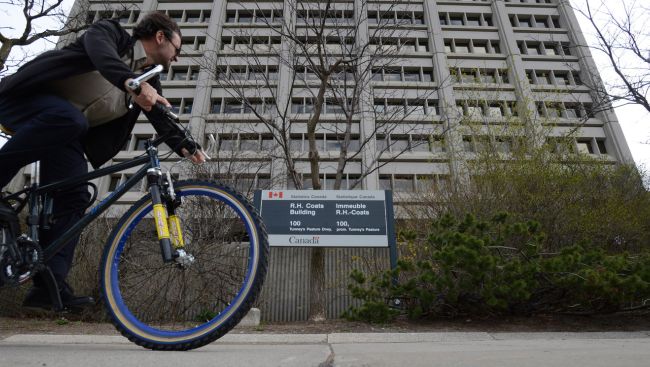
People across the country completed their census forms this week, sharing details about their lives, which languages they speak and — for those who got the long-form census — information about their social and economic situations and access to housing.
Here are five things to know about the questionnaire.
The census is more than 350 years old
The federal government's website says the first census in Canada was launched by Jean Talon, colonial administrator for New France, in 1666.
That census counted the colony's 3,215 inhabitants and recorded their age, sex, marital status and occupation. The website says the information was needed to help plan and develop the colony and Talon did much of the data collection in person by visiting households.
The first Canadian census after Confederation took place in 1871. That questionnaire collected the ancestral origins of all Canadians and asked more than 200 questions covering topics like religion, education, military service, agriculture and finance.
The primary purpose of the 1871 census was to determine how many members of Parliament should be accorded to each district, based on population.
Canadians are now invited to participate in the census every five years. The data collected is used by governments to plan services, develop programs and make decisions about employment, schools, public transportation and hospitals.
There have been controversies
In 2010, Stephen Harper's Conservative government axed the long-form census and replaced it with a voluntary National Household Survey.
The government at the time rejected the protests of associations and organizations which argued that public planners would no longer get an accurate picture of the population and its needs.
The voluntary National Household Survey saw a 68.6 per cent response rate; the response rate was 93.5 per cent when the long-form was mandatory. Data from thousands of smaller communities had to be excluded from the release of the 2011 census results because it was not considered reliable. The cancellation of the long-form also had a direct affect the quality of language statistics.
As one of its first acts in government, Justin Trudeau's Liberals brought back the mandatory, long-form questionnaire in 2015.
There are consequences for not filling it out
Canadians had been asked to fill out the census form by May 12, though Statistics Canada says that's a "reference date" rather than a deadline.
Filling out the census is mandatory and Statistics Canada will send reminder letters to households that don't complete the census by mid-May. Additional followup could involve phone calls and in-person visits to ensure the census is completed.
In mid-July, non-responding households with a mailing address will receive a final reminder letter informing them of their legal obligation to complete the census questionnaire and the possible consequences of failing to do so.
This year, several Canadians took to social media to claim the federal government's national census violates their privacy. Some posted photos of ripped up forms or envelopes marked with "return to sender."
The federal Statistics Act says failure to complete the census can result in a fine of up to $500.
Statistics Canada said while repeated efforts are made to get people to complete the census, there are always some who "refuse to comply." The agency can refer those people to the Public Prosecution Service of Canada to initiate a summary conviction proceeding.
After the 2016 census, Statistics Canada referred 47 cases for such action. It referred 43 cases after the 2021 census.
Lockheed Martin used to provide software for Canada's census
Statistics Canada contracted American defence and aerospace manufacturer Lockheed Martin to provide software for its census operations in 2003, and used the custom-built systems for both the 2006 and 2011 census.
The company's involvement led to several prosecutions related to census refusal.
In 2011, Audrey Tobias, an 89-year-old Toronto peace activist, refused to fill out the census due to Lockheed Martin's involvement in processing census data. Tobias was found not guilty in October 2013 by a Toronto judge who roundly criticized the government for trying to prosecute someone who was a "model citizen."
Janet Churnin, a 79-year-old Toronto woman, also refused to fill out the 2011 census, citing the same concerns about Lockheed Martin's involvement. She was found guilty of violating the Statistics Act and was given a conditional discharge — meaning she would have no permanent criminal record after completing 50 hours of community service within a year.
There is an agriculture-focused census
The census of agriculture is conducted at the same time as the national census and collects information about every farm in Canada.
The federal government's website says since 1921, the census of agriculture has provided information for farm organizations, government departments, agriculture suppliers, service providers and researchers on changes in agriculture.
The website says the data is used to inform decisions about business management strategies and to develop, administer and evaluate agriculture policies that affect farmers and rural communities.
Picture Courtesy: THE CANADIAN PRESS/Sean Kilpatrick