Friday, June 12, 2026
ADVT 
National

COVID-19 deaths hit racialized communities hardest: Stats Can

Darpan News Desk The Canadian Press, 28 Oct, 2020 10:07 PM
  • COVID-19 deaths hit racialized communities hardest: Stats Can

A new Statistics Canada report says communities with the most visible minorities had the highest mortality rates during the first wave of the novel coronavirus.

The report's authors say it is more evidence that the pandemic is disproportionately affecting visible minorities, who are more likely to live in overcrowded housing and work in jobs that put them more at risk of exposure to COVID-19.

Other studies have shown visible minorities are more likely to suffer from conditions such as diabetes and high blood pressure, which are considered to make an individual at higher risk for serious illness or death from COVID-19.

In the four biggest provinces — which account for 99 per cent of the deaths from COVID-19 between March and July — death rates from COVID-19 were twice as high in communities where more than one in four people identify as a visible minority, compared with communities where less than one per cent of residents did.

The death rates are adjusted for age to account for different age structures in different neighbourhoods.

It found in communities where less than one per cent of the population identified as a visible minority, the death in the first wave was 16.9 for every 100,000 people. In communities with a visible minority population between 10 and 25 per cent, the death rate was 27.3 and for communities with visible minority populations of more than 25 per cent, the death rate was 34.5.

In Ontario and Quebec, the rates were 3.5 times as high in communities where more than one-fourth of residents identify as visible minorities.

Nearly 8,800 people died in the first wave of the pandemic in Canada, 94 per cent of them in Quebec and Ontario.

Canadian and provincial public health agencies do not collect much data on the race of patients with COVID-19, so Statistics Canada used the national database on deaths and census data on visible minorities and neighbourhoods to compile the report.

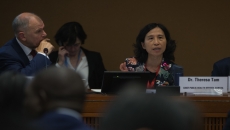
Chief public health officer Dr. Theresa Tam, who said early in the pandemic there were no plans to collect race-based data on cases of COVID-19, said Wednesday that finding out who is most affected by an illness like COVID-19 can help drive policy decisions about where to direct resources.

"So under those circumstances, doubling efforts to focus on providing support, whether it's lab testing, or anything else in those communities, I think would be extremely important," she said.

MORE National ARTICLES

Offers of COVID-19 financial aid from province not enough for Vancouver: mayor

Offers of COVID-19 financial aid from province not enough for Vancouver: mayor
Vancouver's mayor says the financial help being offered by the B.C. government is a "poison chalice" because of the terms it would impose on the city. Kennedy Stewart says borrowing money from the province would saddle Vancouver with a massive deficit that would result in deep service cuts or large property tax increases in the future.    

Offers of COVID-19 financial aid from province not enough for Vancouver: mayor

Horgan tells workers stay home if sick after COVID-19 outbreak at chicken plant

Horgan tells workers stay home if sick after COVID-19 outbreak at chicken plant
B.C. Premier John Horgan says people who are sick must stay away from work after an outbreak of COVID-19 at a chicken processing plant in Vancouver. Horgan said Wednesday workers should not go to work when they are sick because they fear losing wages, and that he was planning a meeting with Labour Minister Harry Bains and WorkSafe BC officials to discuss sick pay provisions.

Horgan tells workers stay home if sick after COVID-19 outbreak at chicken plant

Search for missing B.C. woman prompts homicide fears, second death

Search for missing B.C. woman prompts homicide fears, second death
Police are releasing more details about a British Columbia woman they fear may be the victim of a homicide. Metro Vancouver's Integrated Homicide Investigation Team says 45-year-old April Parisian was last heard from on March 28 and was declared missing earlier this month.

Search for missing B.C. woman prompts homicide fears, second death

Reports of hate crimes are up in Vancouver: police

Reports of hate crimes are up in Vancouver: police
An assault on a 92-year-old Asian man with dementia in Vancouver is being investigated as a hate crime and police say they have recently noticed an increase in reports of hate-motivated incidents. Vancouver police say the man has "severe dementia" and wandered into a convenience store on March 13 when another man yelled racist remarks that included comments about COVID-19.    

Reports of hate crimes are up in Vancouver: police

More signs COVID-19 is slowing in Canada; students to get federal help

More signs COVID-19 is slowing in Canada; students to get federal help
Chief Public Health Officer Dr. Theresa Tam said Canada was making progress in slowing the epidemic but warned against letting down its guard. The focus, Tam said, must be placed on stopping outbreaks in places like seniors homes and in other places where vulnerable populations live together in close quarters. How exactly Canada gets on the road to normalization will largely depend on the provinces, Prime Minister Justin Trudeau said on Wednesday. However, the closure of the Canada-U.S. border will stay in place until May 21st at least, he said.

More signs COVID-19 is slowing in Canada; students to get federal help

Prime Minister Justin Trudeau defends not creating universal COVID-19 benefit, announces student aid

Prime Minister Justin Trudeau defends not creating universal COVID-19 benefit, announces student aid
As he announced yet another emergency financial aid package Wednesday — this one aimed at students — Prime Minister Justin Trudeau defended his decision not to create a universal benefit that would ensure no Canadians affected by COVID-19 fall through the cracks. His focus for specific help Wednesday was students, announcing a $9-billion suite of programs for students whose education and job prospects are disrupted by the novel coronavirus.  Trudeau says his government's approach has been to try to target its emergency financial assistance in stages to those who need it most, rather than to everyone at once, including those who don't need it.      

Prime Minister Justin Trudeau defends not creating universal COVID-19 benefit, announces student aid