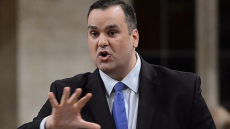
OTTAWA — Canada's finance minister insists low- and middle-income families will see two-thirds of the benefits from the Harper government's contentious multibillion-dollar tableau of family-friendly measures.
By that measure, Joe Oliver is suggesting families with annual incomes as high as $120,000 qualify as middle class.
The Finance Department's own internal breakdown of the distribution of relief from the family package shows 68 per cent of the benefits — about two-thirds — will go to families that earn as much as $120,000 in 2015.
The Canadian Press obtained the figures under the Access to Information Act.
"Two-thirds of the benefits will go to low- and middle-income families," Oliver said Monday while defending the government's family package during Question Period in the House of Commons.
"I'm proud that our government has presented a plan, a benefit plan for four million Canadian families — every one of them."
That family plan, including a controversial $2-billion-per-year income-splitting component, is expected to be a centrepiece of the Tories' re-election campaign when Canadians head to the polls later this year.
It has also become a preferred bull's-eye for their adversaries.
Political opponents have zeroed in on the income-splitting element, calling it an unfair policy that provides no relief for 85 per cent of all Canadian households and provides more benefits to wealthier families.
Looking at the family tax-and-benefit package as a whole, however, the subjective nature of the so-called "middle class" means who exactly stands to benefit — and who does not — remains an open question.
There is no universal definition of the middle class, a term frequently trotted out by politicians as a way to connect with a large group of voters.
Economists prefer to stick to statistical definitions to identify the middle class, such as isolating that 20 per cent of all income earners who land directly in the middle in terms of income.
They may also try to pinpoint the median income, selected by lining up all earners from top to bottom and identifying the person in the middle.
Statistics Canada says the median 2012 income level for families of at least two people was $82,100, including government transfers but before taxes. This measure includes families without kids.
In its internal analysis of the family package, the Finance Department also used income calculated with transfers and before taxes, a spokesman said.
The government's figures show that 25 per cent of the relief will go to families that earn under $30,000 in 2015; 11 per cent to those earning between $30,000 and $60,000; 15 per cent between $60,000 and $90,000; and 17 per cent between $90,000 and $120,000.
Together, these categories represent 68 per cent of the relief. The average relief for families that earn less than $60,000 is expected to be $970, while those in the $60,000 to $120,000 bracket will get an average of $1,219.
The remaining 32-per-cent share will benefit families that bring in more than $120,000 this year.
The average relief for families that take home between $120,000 and $180,000 is $1,183, while those that earn more than $180,000 will receive an average benefit of $1,452.
Overall, the government documents say 4.07 million families will benefit from the measures in 2015 by an average of $1,140 each.
The entire package is expected to reduce government revenues by $4.62 billion in 2015, and $26.7 billion between 2014-15 and 2019-20.
The government's tableau of family measures, announced in October, includes the expansion of the universal child care benefit and an increase to the maximum child-care expense deduction for each child.
It also features income splitting, which will allow an eligible taxpayer with at least one child to transfer up to $50,000 of income to his or her spouse in order to collect a non-refundable tax credit of up to $2,000 per year.