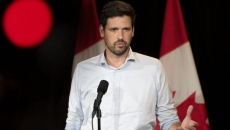
The federal government is opening a research centre that will study the dangers posed by artificial intelligence technology.
Industry Minister François-Philippe Champagne announced the launch of the Canadian Artificial Intelligence Safety Institute in Montreal on Tuesday. He said the centre will be important for building public trust in artificial intelligence technology.
"If you want people to adopt it, they need to have trust," he said. "If there's no adoption, we will squander the incredible potential of many new technologies."
Canada launches AI safety institute to study technology’s risks.
— François-Philippe Champagne (FPC) 🇨🇦 (@FP_Champagne) November 12, 2024
“If there’s no trust, there will be no adoption,” he said of AI. “And if there’s no adoption, we will squander the incredible potential of many new technologies.”
https://t.co/SRU604GwqV pic.twitter.com/SycmLeQvLj
The government says AI can be misused in election interference efforts, disinformation campaigns and cybersecurity breaches.
At a meeting in Soeul in May, world leaders agreed to build a network of publicly backed safety institutes to advance research and testing of the technology. Champagne said Canada was among the first countries to launch such an institute.
The Canadian Artificial Intelligence Safety Institute will collaborate with similar organizations in other countries as part of the International Network of AI Safety Institutes, which is set to hold its first meeting in San Francisco next week.
Governments and global bodies have been working to design guardrails for AI amid expert warnings the technology, which is already changing everyday life, could pose an existential risk.
The centre will be based at Innovation, Science and Economic Development Canada. It will receive $50 million over five years from Ottawa, part of $2.4 billion in AI-related funding announced in this year's federal budget.
The institute will work on projects directed by the government focusing on priorities like cybersecurity and joint testing with other countries. The government will also fund research by Canadian and international experts through the Canadian Institute for Advanced Research.
Elissa Strome, executive director of Pan-Canadian AI strategy at the Canadian Institute for Advanced Research, said global collaboration is essential because AI technology doesn't have borders.
Canada is a longtime leader in AI research, she said. "It's the value-add that Canada brings to the global conversation, is this expertise and this leadership that we have in AI research."
At the meeting in San Francisco, representatives from AI institutes around the world will look at emerging topics and opportunities for collaboration, she said.
"We hope to be able to come back from that meeting with some ideas on where we want to focus, at least to start with."
Strome said there are already concerns and issues with how AI is being deployed, including misinformation, disinformation and synthetic content like deepfakes, but also opportunities to develop new technical approaches to identify or prevent false content.