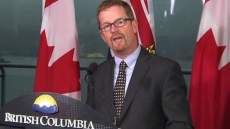
OTTAWA — Justice Minister Jody Wilson-Raybould has a message for critics who suggest she is backtracking on the government's pledge to bolster indigenous rights in Canada: she isn't.
The lawyer and former Assembly of First Nations B.C. regional chief says she has spent her career working on indigenous legal issues and she is not "turning away" now.
Wilson-Raybould became the subject of news coverage last week after she delivered a speech at the AFN annual meeting in Niagara Falls, Ont.
During the remarks, she noted "simplistic approaches" like adopting the United Nations Declaration on the Rights of Indigenous Peoples into Canadian law are "unworkable."
The comment raised the eyebrows of some observers, who wondered if this was a sign the government was shying away from its pledge to implement the UN declaration, which enshrines indigenous rights to self-determination.
That's far from the case, Wilson-Raybould said in an interview with The Canadian Press.
She also went further, saying the government supports all articles of the declaration "without reservation."
UNDRIP — a document adopted by the United Nations in September 2007, after more than two decades of deliberation — spells out rights that constitute the minimum standards for "the survival, dignity and well-being of the indigenous peoples of the world."
One central article recognizes the right to self-determination and notes indigenous peoples have the right to the lands, territories and natural resources which they traditionally owned or occupied.
The challenge for the government is implementing the declaration, Wilson-Raybould said, adding that this could take different shapes and that must be done in partnership.

"It is no longer a question of if we are going to do it. We certainly are, it is more a question of how we are going to implement it here in Canada," she said.
Specific articles from the declaration need to be implemented differently based on solutions from communities themselves, she added.
"We can, as a federal government, facilitate that transition by creating the mechanisms that are required, whether it be through law, (or) various pieces of legislation that implement particular articles in the declaration," Wilson-Raybould said.
"Other articles might be implemented through modern-day treaties or other constructive mechanisms."
The government needs to assist communities as they move away from a "ward-like" relationship with the federal government established under the Indian Act, she added.
"We (the government) have a fiduciary obligation and responsibility to indigenous peoples to provide programs and services and that's not going to change," she said.
"How that will change ... is, when communities are ready and willing and able, and not every community is, that we support those communities in transitioning out from the Indian Act."
The work needed to accomplish this goal will be challenging and controversial, Wilson-Raybould conceded, but she is happy it is being discussed.
"I hope people turn their mind to, I have to as the minister of justice ... about how we are going to implement the declaration here in Canada," she said.
Adopting and implementing the UN declaration are also among the 94 calls to action presented last year by the Truth and Reconciliation Commission.
The Liberal government committed to implementing all recommendations from the commission, which spent six years probing Canada's dark residential school legacy.
NDP intergovernmental indigenous affairs critic Romeo Saganash — a residential school survivor who worked for two decades on an international effort to craft the declaration — has been pressing the government to support his private member's bill calling for a legislative framework for UNDRIP's application in Canadian law.
The proposed legislation has been endorsed by several members of the indigenous community including former TRC chairman Murray Sinclair, now a senator.