A new international study suggests thousands of glaciers across Canada's Arctic could be saved from total extinction if humanity can bend the curve on global warming.
Yet, the study offers a grim outlook for the world's glaciers, suggesting close to 80 per cent would be lost at the planet's current trajectory of around 2.7 degrees by the end of the century.
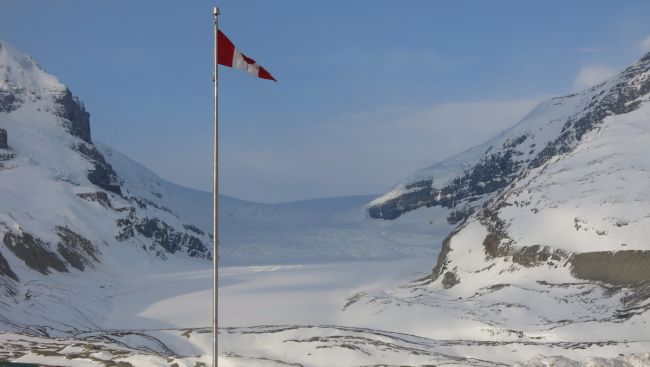
At that rate, the vast majority of glaciers in Western Canada and the United States would be wiped out.
The Swiss-led research team behind the peer-reviewed study published in Nature Climate Change modelled glacier extinction levels under four different warming scenarios.
The results suggest Canada’s southern Arctic could lose 34 per cent of its glaciers under 1.5 degrees of warming, compared to up to 60 per cent if the world continues on its current trajectory of around 2.7 degrees.
At a catastrophic four degrees of warming, virtually every glacier in Western Canada and the United States would be wiped out, along with 81 per cent of those in the southern Arctic.
The researchers say studies have often focused on dwindling glacier mass as a way to better understand future sea level rise and water scarcity issues for the many communities who depend on glacier meltwater.
One 2023 study in the journal Science estimated glaciers, excluding Antarctica and Greenland ice sheets, could lose a quarter of their mass under 1.5 degrees of warming or up to two-thirds under four degrees. A lot of that water is held in a few very large glaciers that could still persist until the end of the century.
With Monday’s study, the researchers say they wanted to place the focus on sheer number of glaciers facing extinction. They highlighted how glaciers are not only water resources but can be influential cultural or spiritual landmarks and important tourism sites.
“The loss of glaciers that we are speaking about here is more than just a scientific concern. It really touches our hearts, and therefore it can spread a very powerful message also to a broader public,” said co-author Matthias Huss, a glaciologist with the team out of ETH Zurich.
Climate change, driven by the burning of fossil fuels, has already taken a massive chunk out the world's glaciers. A study published earlier this year estimated glaciers have lost about 6.5 trillion tonnes of ice since the early 2000s, with those losses rapidly accelerating in recent years.
The researchers behind Monday's study simulated the evolution of each of the world's more than 200,000 glaciers, outside the Antarctic and Greenland ice sheets. Using three different models, they estimated the moment each of those glaciers would become too small to classify as a glacier under four different warming scenarios: 1.5 degrees, two degrees, 2.7 degrees and four degrees.
With this paper, the researchers have coined the term "peak glacier extinction" to describe the year when the largest numbers of glaciers are expected to disappear between now and the end of the century.
At 1.5 degrees of warming, about 2,000 glaciers disappear every year at a peak around 2041. At four degrees, the peak shifts to the mid-2050s and intensifies to around 4,000 glaciers per year as global warming melts away larger glaciers.
Recent estimates suggest the world is on pace to warm by roughly 2.7 degrees if countries implement their current climate policies – by no means guaranteed. That's well above the international targets to keep warming below two degrees and aim for 1.5, to avoid some of the most catastrophic and irreversible climate impacts.
Recent studies have suggested the 1.5-degree target could be breached within the decade, though scientists broadly insist every fraction of a degree will be important to avoid worsening climate impacts.
In Canada's southern Arctic, 60 per cent of the region's 7,406 glaciers would be wiped out by the end of the century if the world continues at its current pace. If warming is kept to two degrees, it would save an estimated 1,362 glaciers from total extinction. At 1.5 degrees, another 575 glaciers on top of that would stay above the extinction threshold.
Averaged across warming scenarios, the region would lose about 78 glaciers at its peak extinction year in 2081.
In the northern Arctic, the projected losses are stark though less dramatic than in the south. At the world's current trajectory, about 30 per cent of the region's 4,500 glaciers would vanish, compared to 23 per cent and 19 per cent if warming is kept at two degrees or 1.5 degrees, respectively.
In Western Canada and the United States, the outlook is far worse.
Of the region's 17,723 glaciers, 96 per cent could disappear at the world's current trajectory. That comes down to 82 per cent at two degrees, or 75 per cent at 1.5 degrees.
At four degrees of warming, only 101 glaciers in the region are left, the study suggests.
Picture Courtesy: THE CANADIAN PRESS/Bill Graveland