VANCOUVER - A year after the heat dome event that killed billions of plants and animals in British Columbia, scientists say ecosystems are recovering, but could be transformed forever if such events become more frequent.
Cold-water marine species could be replaced by warm-water organisms, triggering cascading effects through the environment, said Christopher Harley, a zoology professor at the University of British Columbia.
"If we had another heat wave this summer, it would be a problem," he said. "An ecosystem might be able to handle a big heat wave once every few decades — there's enough time for recovery — but if it starts hitting every four or five years, the species that we're used to just can no longer persist."
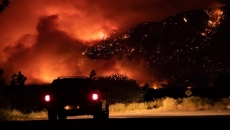
Dozens of temperature records were set during the heat dome. The high-pressure system settled over Western Canada, acting like a lid to trap a layer of hot air that got progressively hotter for about a week. Three successive Canadian records were set in the town of Lytton, where the temperature topped out at 49.6 C on June 30, the day before fire destroyed most of the village.
The heat caused more than 600 human deaths, the BC Coroners Service reported. It also led to mass mortalities of marine life, reduced crop yields and contributed to wildfires, which later caused devastating landslides last fall.
Diane Srivastava, director of the Canadian Institute for Ecology and Evolution,organized a group of scientists now working to understand the heat dome's impact on species and ecosystems. She said some were "immediate and obvious" but several years of data is required to "get a full picture of the longer-term effects."
Harley, a member of the group, said the heat wave caught researchers off guard and they are now "scrambling to understand" what it will mean for the oceanic ecosystem.
"I'm a bit embarrassed to say we don't know (the ecological consequences) because it hadn't occurred to us to ask what would happen if it got hot enough to kill billions of marine animals," he said. "That heat dome was so far outside of what anyone expected."
Scientists initially estimated more than a billion marine animal died along the Pacific coast. Harley, who has studied shorelines on the West Coast since 1995, said this was an underestimation.
"Easily many billions of animals died," he said. "It was a perfect storm of a few different things. It was obviously much, much hotter than usual and those high temperatures coincided with very low tides."
Species with mobility had a higher survival rate than those that anchor to rocks in shallow waters, he explained.
"Mussels aren't back yet and some of the common seaweeds are not, but baby barnacles are having the time of their lives. They're all over the place and the first step in recovery is (when) they come in," he said. "The foundation has now been laid."
Adam Ford, an assistant professor and Canada Research Chair in Wildlife Restoration Ecology at the University of British Columbia, said the large mammals he studies were far less impacted by the heat than oceanic life.
"We've got a couple of years of data under our belt and there wasn't a bump in mortality or anything during that time."
He said this is because large mammals are homeothermic, meaning they can regulate their body temperatures, and were able to move to cooler areas to avoid direct heat.
Karen Hodges, a professor of conservation ecology at the University of British Columbia, said most mobile animals and those that burrow into the soil likely fared better during the wildfires that followed the heat dome than those unable to flee quickly. She said it's difficult to estimate total deaths because it would require "many assumptions about animal densities" before the fires.
How fast an area's ecosystem recovers depends on environmental aspects like soil moisture, but hinges on fire management practices and climate change response, Hodges said.
"The answer to what comes back becomes a question of what humans do to these landscapes in the next decade, two decades if you want to be generous, because we could either set up the conditions for low levels of frequent, small fires or we could set up conditions that enable repeats of these massive fires," she said. "It's a pivotal time."
Ford echoed the call for better wildfire practices to mitigate impacts of intense heat.
"We already know that climate change and poor management practices, like fire suppression, for the last 50 to 70 years has really degraded the health of our forests. So you put those two things together, we've got a recipe for catastrophic failures that trickled through all sorts of areas of society, including biodiversity," he said.
"We need to figure out how we put fire back on the landscape in an amount and intensity that restores habitat for wildlife and people."
Wildland fires are a natural part of the forest ecosystem and important for maintaining the health and diversity of the forest, Natural Resources Canada says on its website.
"Prescribed fires offer a valuable resource management tool for enhancing ecological conditions and eliminating excessive fuel buildup," the website says.
For decades, scientists in B.C. have been calling for the use of low-severity fires to “maintain” forest health by creating fire breaks. Hodges said fire suppression efforts made to protect communities eliminated many of those natural breaks, allowing fires to spread more easily.
She said the provincial report following B.C.'s historic 2003 wildfires, which forced the evacuation of over 45,000 people from the province's interior, was a turning point.
"That report is full of advice about letting some fires burn, about FireSmart communities and about prescribed fire and all sorts of things that the province basically didn't do, but that advice has been in government hands since at least that report," she said.
Hodges said large fires can also compound climate change-related weather events, like the catastrophic floods that took place in B.C. last fall. She said fires that kill thousands of trees affect soil composition and can make it hydrophobic, meaning it repels water. Then, when heavy rains occur, water isn't absorbed into the soil, causing landslides.
"Things like this are way more common after these big, hot lethal fires than after the small run-of-the-mill fires we've had in our history," she said.
The Ministry of Forests said in a statement that it uses prescribed burning as "one of several fuel management tools and techniques to help reduce the intensity of naturally occurring wildfires while returning an integral process to the ecosystem."
Rachel White, the lead author of a report into the widespread ecological impacts of the 2021 heat wave, currently under peer review, said the lack of synthesized data has been a major barrier for scientists.
"We're going to have more frequent and hotter heat waves, and this is going to have an impact on all of the ecology. In order to monitor that, we need data," she said.
"We need that data in order to actually understand what the impacts are and, once we know how systems are responding now, that gives us more information to say how they'll respond in the future if the climate continues to warm through human actions."
Harley, the zoology professor, and his team is working to better understand what makes an ecosystem more or less sensitive to a heat waves.
"There may be small changes that we can make so ecosystems are more resistant to something like a big heat wave or a big drought," he said.
Srivastava said the Institute for Ecology and Evolution has been advocating for a provincial biodiversity monitoring network.
"Events like this sort of point out the need to have such a monitoring network for biodiversity already in place, which would allow us to have a long-term monitoring of many populations," she said. "Instead, what we're having to do is pull together data from many different sources to try to see the immediate effects and then the long-term effects."
She said the development of a network is "a recent and ongoing subject of conversation" with provincial and federal governments.
B.C.'s Environment Ministry confirmed it is working to synthesize ecology research and data on climate change as part of its new Climate Preparedness and Adaptation Strategy.
"Understanding how climatic disruption will affect ecosystems is essential to responding to climate change," it said in an statement. "The province is supporting the establishment of an Ecosystem Forecast Centre within the Ministry of Forests to build expertise and resources to translate technical climate change projections into forecasts of ecosystem change in B.C."