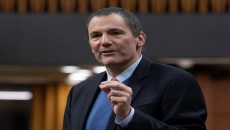
The head of the Public Health Agency of Canada is showing no sign he's willing to release unredacted documents about the firing of two scientists at the country's highest security laboratory — despite the prospect of being publicly shamed in the House of Commons for his refusal to produce the information.
PHAC president Iain Stewart told the Commons health committee Friday that he is bound by law to protect national security and privacy rights.
And he said nothing in a House order demanding that he produce the documents relieves him of that obligation.
"I am a career public servant and, as a career public servant, I am required to follow the law," Stewart told the committee.
He said he's following the advice he's received from "legal and security experts" in the Justice Department.
"As accountable head of the Public Health Agency, I am the person ... who provides the documents and, hence, I find myself in this extraordinary situation in this 27th year of my career. But it's not the exercise of my choice that's putting me here, it's the obligations of my job."
Opposition parties joined forces earlier this week to pass a motion finding PHAC in contempt of Parliament and summoning Stewart to appear Monday before the bar of the Commons to be reprimanded by the Speaker and to produce the documents.
Stewart said he looks forward to Monday "as it comes." He refused to say specifically whether he'd hand over the documents at that time but his testimony under persistent opposition questioning Friday suggested he will not.
Calling someone to the bar of the House is a rarely used procedure to essentially publicly shame a person deemed to have committed "an offence against the dignity or authority of Parliament," according to House of Commons Procedure and Practice.
Since 1913, it has not been used against a private citizen, although it has been used twice, in 1991 and 2002, to discipline MPs who had grabbed the ceremonial mace during heated Commons proceedings.
Stewart has twice refused an order from the Canada-China relations committee to produce unredacted documents that would shed light on why scientists Xiangguo Qiu and her husband, Keding Cheng, were escorted out of Winnipeg's National Microbiology Laboratory in July 2019 and subsequently fired last January.
He has similarly refused to comply with a Commons motion passed by opposition parties earlier this month to turn over all unredacted documents to the parliamentary law clerk, who would confidentially review them and redact anything he felt would compromise national security or the ongoing police investigation.
That motion specified that the Canada-China relations committee, after consulting with the law clerk, could choose to make public any redacted material.
PHAC has instead turned over the unredacted documents to the National Security and Intelligence Committee of Parliamentarians, whose members have top security clearance and are bound to secrecy.
Commons Speaker Anthony Rota ruled Wednesday that giving the documents to that body is not sufficient to comply with the House order since it is not a committee of Parliament. He further ruled that the Commons and its standing committees have unfettered power to order the production of unredacted documents, no matter how sensitive, and to determine how they're to be handled.
Opposition members of the health committee repeatedly referred to that ruling Friday, demanding Stewart recognize that Parliament is supreme and to finally comply with the order to turn over the documents.
"Nothing in the motions heretofore have made me not legally liable for the choice I'm being asked to make," Stewart told them.
He asked in turn if MPs believe the House order and Speaker's ruling provide him with "immunity" for breaking the Privacy Act and the Security of Information Act.
"Is that what this is about, Mr. Stewart? Your own hide?" shot back NDP health critic Don Davies.
"As a public servant, I'm bound by law and I have to follow the law," Stewart replied.
Conservative health critic Michelle Rempel Garner pointed out that an order of the House of Commons is also lawful. Indeed, the parliamentary law clerk has advised the committee that a House order supercedes other statutes passed by Parliament.
However, Liberal MP Jennifer O'Connell argued that releasing the documents to parliamentarians without the proper security clearance could allow Russia, China and other "bad actors" to gain access to sensitive information.
Stewart agreed that "materials related to a level four lab are of interest to many parties." Indeed, he said the "cumulative effect" of the little unredacted material PHAC has released so far about scientists' firing "does, in and of itself, begin to create security concerns for the intelligence community."
The impact of releasing unredacted the other classified documents "would be even more profound," Stewart said.
Members of the Canada-China relations committee to whom he was ordered to release the documents do not have security clearance and don't have the ability to handle classified documents or even to have secure communications about them, he added.
"It's done over the worldwide web," he said.