Thursday, July 2, 2026
ADVT 
National

Relaxed travel restrictions coming soon

Darpan News Desk The Canadian Press, 15 Jun, 2021 04:19 PM
  • Relaxed travel restrictions coming soon

Intergovernmental Affairs Minister Dominic LeBlanc is signalling that Canadians can expect an announcement by Monday on easing pandemic travel restrictions.

But he warned Tuesday that the relaxed rules won't necessarily go into effect immediately. And he stressed that the restrictions will be phased out slowly and cautiously and only so long as vaccination rates continue to climb and the number of COVID-19 cases in Canada continues to decline.

The government has been deciding on a monthly basis whether to renew the restrictions, with the current orders-in-council due to expire Monday.

"Next week we’ll have more to say about measures that will be in place at both the land borders and the air arrivals at the four designated airports," LeBlanc told a pandemic briefing Tuesday.

"The good news is we hope and believe these measures can evolve in a phased appropriate way over the next number of weeks. We’ll have more to say about those specific measures and the implementation details in the coming days."

He added that "this shouldn’t be a surprise because we talked about potential measures that could be phased in at some point in July."

While the government is signalling "some modest phased-in adjustments at the border" on Monday, LeBlanc said, "it doesn't have to take effect on the 21st of June."

The government has already said it will relax quarantine protocols in early July for fully vaccinated citizens who are eligible to return to Canada.

Currently, all non-essential travel into Canada is prohibited, with limited exceptions. Those allowed to enter face multiple COVID-19 test requirements and must quarantine for 14 days.

Travellers arriving by air can land at only four designated airports in Canada and must quarantine, at least initially and at their own expense, in a designated hotel.

Business groups have been pressuring the government to ease up on travel restrictions, particularly at the Canada-U.S. border. The hard-hit tourism, hospitality and airlines sectors in particular are hoping for relaxed rules that will allow some resumption of tourist travel.

LeBlanc said the government is well aware that businesses want a clear timeline for relaxing travel restrictions.

"In a perfect world we would have been able to set dates with a long runway but, unfortunately, COVID hasn't given the world this opportunity," he said.

He noted that the United Kingdom has had to adjust its reopening schedule due to a rise in cases of the more transmissible Delta variant of the virus.

"Canada is not immune from having to make those adjustments."

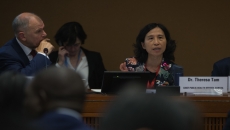
Chief public health officer Dr. Theresa Tam said she expects travel restrictions will be relaxed somewhat for travellers who've been fully vaccinated. But she said it will be a long time before restrictions can be entirely lifted.

"One would expect the borders are not going to be the same as what they were before the pandemic and additional measures will be applied for a significant length of time until the world is a different place," she said.

Prime Minister Justin Trudeau and U.S. President Joe Biden talked about the land border restrictions during a discussion on the sidelines of this week's G7 summit. LeBlanc said conversations between the two countries are continuing, led by Public Safety Minister Bill Blair.

Canada is also working with the provinces, the U.S., the European Union and other allies on development of a secure, reliable way to recognize proof of vaccination, LeBlanc said.
MORE National ARTICLES

Offers of COVID-19 financial aid from province not enough for Vancouver: mayor

Offers of COVID-19 financial aid from province not enough for Vancouver: mayor
Vancouver's mayor says the financial help being offered by the B.C. government is a "poison chalice" because of the terms it would impose on the city. Kennedy Stewart says borrowing money from the province would saddle Vancouver with a massive deficit that would result in deep service cuts or large property tax increases in the future.    

Offers of COVID-19 financial aid from province not enough for Vancouver: mayor

Horgan tells workers stay home if sick after COVID-19 outbreak at chicken plant

Horgan tells workers stay home if sick after COVID-19 outbreak at chicken plant
B.C. Premier John Horgan says people who are sick must stay away from work after an outbreak of COVID-19 at a chicken processing plant in Vancouver. Horgan said Wednesday workers should not go to work when they are sick because they fear losing wages, and that he was planning a meeting with Labour Minister Harry Bains and WorkSafe BC officials to discuss sick pay provisions.

Horgan tells workers stay home if sick after COVID-19 outbreak at chicken plant

Search for missing B.C. woman prompts homicide fears, second death

Search for missing B.C. woman prompts homicide fears, second death
Police are releasing more details about a British Columbia woman they fear may be the victim of a homicide. Metro Vancouver's Integrated Homicide Investigation Team says 45-year-old April Parisian was last heard from on March 28 and was declared missing earlier this month.

Search for missing B.C. woman prompts homicide fears, second death

Reports of hate crimes are up in Vancouver: police

Reports of hate crimes are up in Vancouver: police
An assault on a 92-year-old Asian man with dementia in Vancouver is being investigated as a hate crime and police say they have recently noticed an increase in reports of hate-motivated incidents. Vancouver police say the man has "severe dementia" and wandered into a convenience store on March 13 when another man yelled racist remarks that included comments about COVID-19.    

Reports of hate crimes are up in Vancouver: police

More signs COVID-19 is slowing in Canada; students to get federal help

More signs COVID-19 is slowing in Canada; students to get federal help
Chief Public Health Officer Dr. Theresa Tam said Canada was making progress in slowing the epidemic but warned against letting down its guard. The focus, Tam said, must be placed on stopping outbreaks in places like seniors homes and in other places where vulnerable populations live together in close quarters. How exactly Canada gets on the road to normalization will largely depend on the provinces, Prime Minister Justin Trudeau said on Wednesday. However, the closure of the Canada-U.S. border will stay in place until May 21st at least, he said.

More signs COVID-19 is slowing in Canada; students to get federal help

Prime Minister Justin Trudeau defends not creating universal COVID-19 benefit, announces student aid

Prime Minister Justin Trudeau defends not creating universal COVID-19 benefit, announces student aid
As he announced yet another emergency financial aid package Wednesday — this one aimed at students — Prime Minister Justin Trudeau defended his decision not to create a universal benefit that would ensure no Canadians affected by COVID-19 fall through the cracks. His focus for specific help Wednesday was students, announcing a $9-billion suite of programs for students whose education and job prospects are disrupted by the novel coronavirus.  Trudeau says his government's approach has been to try to target its emergency financial assistance in stages to those who need it most, rather than to everyone at once, including those who don't need it.      

Prime Minister Justin Trudeau defends not creating universal COVID-19 benefit, announces student aid