
Thursday, May 14, 2026
ADVT 
National

Timeline of B.C.'s three-year drug decriminalization pilot project

Darpan News Desk The Canadian Press, 15 Jan, 2026 09:49 AM
  • Timeline of B.C.'s three-year drug decriminalization pilot project

British Columbia's three-year pilot project that decriminalized the possession of small amounts of illicit drugs for personal use is set to end on Jan. 31. 

Health Minister Josie Osbourne has announced B.C. will not be extending the program. Here are some of the key moments in its history.

May 31, 2022

Health Canada grants the B.C. government's request for an exemption from s. 56 of the federal Controlled Drugs and Substances Act.

Jan. 31, 2023

The three-year exemption is implemented in B.C. The change decriminalizes the personal possession of up to 2.5 grams cumulatively of opioids, crack and powdered cocaine, methamphetamine and MDMA for adults. Possession continues to be prohibited around schools, childcare facilities, airports and during the operation of motor vehicles.

Nov. 8, 2023

The Restricting Public Consumption of Illegal Substances Act receives Royal Assent in the B.C. legislature. The bill prohibits consumption of illegal substances in public spaces and authorizes police to seize them and/or direct people to stop. Three days later, the Harm Reduction Nurses Association asks B.C. Supreme Court to declare Bill 34 unconstitutional. The court later grants a temporary injunction, preventing the bill from going into effect.

Jan. 31, 2024

Mental Health and Addictions Minister Jennifer Whiteside releases a statement marking the one-year anniversary of decriminalization, saying ending the project won't save "a single life."

May 7, 2024

Health Canada grants an amendment that curtails B.C.'s exemption. Decriminalization is restricted to possession in private homes and places where homeless people are legally sheltering, as well as overdose prevention, drug checking and supervised consumption sites and health-care clinics providing outpatient addiction services.

Jan. 6, 2026

When asked about extending B.C.'s exemption that allows for decriminalization, Premier David Eby says the province is "not going back to the old policy of decriminalized public drug use in British Columbia." He says "it didn't work and we ended that."

Jan. 14, 2026

Health Minister Josie Osborne announces the province will not seek an extension of its exemption agreement with Health Canada. Osborne says the goal of the pilot project was to make it easier for people to come forward and seek help, but it "hasn't delivered the results" officials hoped for.

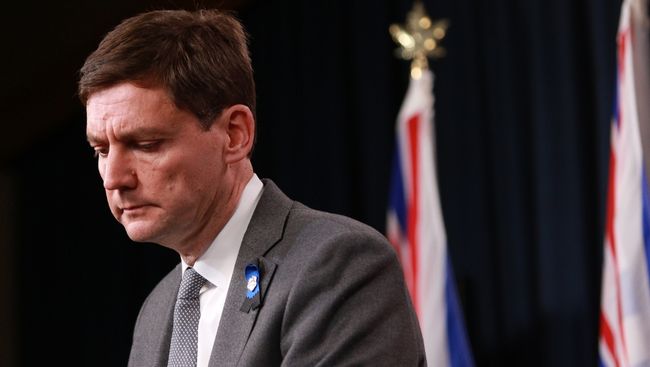
Picture Courtesy: THE CANADIAN PRESS/Chad Hipolito


MORE National ARTICLES

New poll suggests 40% of Canadians fear losing their jobs due to Trump's tariffs

New poll suggests 40% of Canadians fear losing their jobs due to Trump's tariffs
A new poll suggests that 40 per cent of Canadians are worried about losing their jobs as many businesses scale back hiring plans in response to the trade war with the United States. The Leger poll, which sampled more than 1,500 Canadian adults from March 7 to March 10, suggests that more than half of workers in Ontario were concerned about job security, the highest in the country, while just under one in four in Atlantic Canada said they were worried.

New poll suggests 40% of Canadians fear losing their jobs due to Trump's tariffs

Trump's ambassador pick says Canada is sovereign as president threatens annexation

Trump's ambassador pick says Canada is sovereign as president threatens annexation
The man set to become America's top diplomat in Ottawa said Thursday that Canada is a sovereign state — contradicting U.S. President Donald Trump, who is doubling down on his calls to make Canada a U.S. state.

Trump's ambassador pick says Canada is sovereign as president threatens annexation

'Get ready for a wild ride': Weather Network issues Canada's spring forecast

'Get ready for a wild ride': Weather Network issues Canada's spring forecast
Canada's recent flirtation with balmy temperatures will give way to spring's characteristically volatile weather, the Weather Network's chief meteorologist said, with a new seasonal forecast suggesting winter may still deliver some parting punches. Spring may be slightly chillier in Western Canada but otherwise close to normal in the rest of the country, the forecast suggests. But prepare for the ups and downs of what's typically Canada's most fitful season, said the Weather Network's Chris Scott. 

'Get ready for a wild ride': Weather Network issues Canada's spring forecast

Tools, electronics, sports equipment from the U.S. hit with Canadian counter-tariffs

Tools, electronics, sports equipment from the U.S. hit with Canadian counter-tariffs
Many consumer goods could be up to 25 per cent more expensive in Canada due to retaliatory tariffs against the U.S. — including the kitchen sink. Matching 25 per cent tariffs on $29.8 billion worth of American goods took effect just after midnight in response to U.S. President Donald Trump's tariffs on steel and aluminum imports.

Tools, electronics, sports equipment from the U.S. hit with Canadian counter-tariffs

Joly says G7 foreign ministers 'must meet the moment' as she floats maritime projects

Joly says G7 foreign ministers 'must meet the moment' as she floats maritime projects
Foreign Affairs Minister Mélanie Joly said Thursday she's focused on working with Canada's peers to address global challenges as she welcomes her counterparts from the U.S., Europe and Japan to Quebec. Joly spoke with U.S. Secretary of State Marco Rubio individually before opening the G7 foreign ministers' meeting Thursday morning.

Joly says G7 foreign ministers 'must meet the moment' as she floats maritime projects

U.S. tariffs push Ottawa to invest more in Canadian steel, aluminum projects

U.S. tariffs push Ottawa to invest more in Canadian steel, aluminum projects
Industry Minister François-Philippe Champagne directed his department on Wednesday to prioritize investments in projects that primarily use Canadian steel and aluminum — part of Ottawa's reply to the Trump administration's trade war. The move comes as Canada's steel industry starts laying off workers in anticipation of production slowdowns.

U.S. tariffs push Ottawa to invest more in Canadian steel, aluminum projects