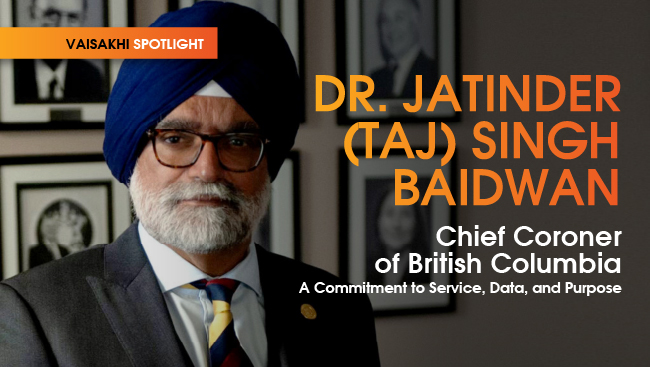
As the first turbaned Sikh Chief Coroner of British Columbia, Dr. Jatinder (Taj) Baidwan represents more than a milestone in leadership. He embodies a journey shaped by service, resilience, and a deep commitment to community. In a role that sits at the intersection of medicine, public service, and human understanding, Dr. Baidwan brings decades of experience along with a perspective grounded in Sikh values.
Raised in London, England, to Sikh immigrant parents, Dr. Baidwan’s story is rooted in perseverance and identity. His father, Beant Singh Baidwan, arrived in the United Kingdom in the 1960s and refused to compromise his faith when asked to cut his hair for employment, taking on difficult jobs before becoming a civil servant. His mother, Gurcharan Kaur Baidwan, played an equally important role in instilling hard work, resilience, and faith. Those values left a lasting imprint. “It is never wrong to do the right thing,” he reflects, a principle that has quietly guided every stage of his life.
Dr. Baidwan joined the British Army at a young age and went on to serve as a medical officer for nearly two decades, working across numerous conflict zones and global crises, including deployments in Iraq and Bosnia, and humanitarian efforts following the 2004 Indian Ocean tsunami. Alongside clinical work, he built parallel paths in research and leadership. These experiences shaped both his clinical expertise and leadership perspective, allowing him to move seamlessly between frontline care and executive roles.
“I’ve always approached things as a systems person,” he explains. “You don’t change a system based on opinion. You change it based on data. I cannot tell the Ministry of Health what policy to write, but I can show, through data, whether what they’re doing is working or not.” That mindset became the foundation of his leadership, guiding both his decisions and the direction of his career.
In 2007, Dr. Baidwan moved to Victoria with his wife, Maninderjit Kaur Baidwan, and their three young children. Within months, he established his clinical practice while contributing to medical education. “There was never a point where I decided to leave medicine,” he notes. “I’ve always kept my clinical work going. It was always about asking where I could be most helpful.” That question led him into senior leadership roles within British Columbia’s healthcare system, including Island Health and the Health Employers Association of BC.

Dr. Baidwan’s transition into the BC Coroners Service in 2017 was driven by a desire to improve a system that was not working efficiently. At the time, post-mortem processes were dependent on the broader health-care system, where growing backlogs meant families often waited weeks for autopsies and months for answers. Drawing on his experience, he spearheaded a more effective post-mortem diagnostic system across the province.
In 2024, he stepped into the role of Chief Coroner of British Columbia, approaching it not as a title but as a responsibility. He outlines, “In this role, everything comes down to five essential questions: who the person is, when, where, and how they died, and by what means. Our role is to answer those questions clearly and record them in a way everyone can understand, in a Coroner’s report at the conclusion of our investigation.”
Behind those questions lies deeply human work. Every case represents a family’s most difficult moment. “When we meet families, it is often the worst day of their lives,” he shares. “Our job is simple. Be honest. Be clear and treat people with the respect they deserve as we carry out our investigation. Similarly, we ask for honesty from members of our community as we perform our duties.”

While widely recognized for his data-driven approach, Dr. Baidwan is clear that empathy is not separate from the work he does. It is embedded within it. During the COVID-19 pandemic, when death tolls surged globally, his team made a conscious decision to preserve humanity in every process. “We never saw people as numbers,” he emphasizes. “Every person was treated with respect. That mattered.”
His leadership style reflects the same balance of accountability and compassion. Rather than directing from the top, he leads through reflection. “If something doesn’t feel right, I don’t jump in with answers. I ask questions,” he observes. “Because when people are upset, it’s rarely just about the outcome. It’s about how they were treated and how they were made to feel.”
At the heart of his approach are Sikh values, particularly seva, or selfless service. For Dr. Baidwan, this is not something separate from his identity. “It’s not something I switch on,” he adds. “It’s who I am. Seva is about understanding the needs of others and putting them before your own.” That perspective also shapes how he defines success.
“It’s never been about money or titles,” he reflects. “When you go, you don’t take any of it with you. You take your karam with you.” Instead, the focus remains on contribution. “It’s not about legacy,” he continues. “It’s about making a meaningful impact while you’re here.”

As Chief Coroner, Dr. Baidwan remains focused on strengthening the system through better data, stronger collaboration, and a deeper understanding of preventable deaths. Beyond policy and process, his work is grounded in a simple philosophy. “Step forward, not for personal gain, but to be of service,” he encourages. “Ask yourself where you can make the most impact. If you lead with that, you will be happier.”
As this time of year celebrates renewal, service, and community, Dr. Jatinder (Taj) Baidwan’s journey reflects those very values. From the son of immigrants who refused to compromise their identity, to becoming the first turbaned Sikh Chief Coroner of British Columbia, his story is a powerful reminder that leadership, at its core, is about purpose, courage, and service to others.