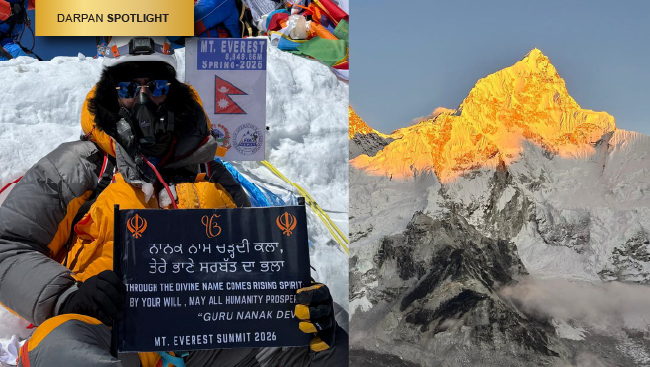
At 8,848 meters above sea level, the summit of Mount Everest is often described as the roof of the world. On May 20, 2026, Ajaypal Singh Dhaliwal became the first Sikh from Canada to reach it, a milestone celebrated across communities in Canada and beyond. For the Surrey-based lawyer, the achievement marked the culmination of years of training and perseverance, but the mountain's greatest lesson came during a perilous descent from the summit, an experience that left him with a renewed appreciation for humility, gratitude, and the value of everyday life.
Born in Kassam Bhatti village in Punjab's Faridkot district before later settling in Canada, Dhaliwal did not set out to become a mountaineer. Although he had always enjoyed hiking, he only began pursuing it seriously a few years ago. "I always loved mountain climbing," he shares. "But I really started taking it seriously around 2023."
After completing the Everest Base Camp trek in Nepal in 2023, Dhaliwal set his sights on something bigger. He began training rigorously, progressing from weekend hikes to running and endurance sports. "I started running 5K, then 10K. I had never run even one kilometer in my life before that," he recalls. When he questioned whether he was too old to attempt Everest, a veteran climber reassured him: "It's about attitude. Age is just a number."
That advice stayed with him.
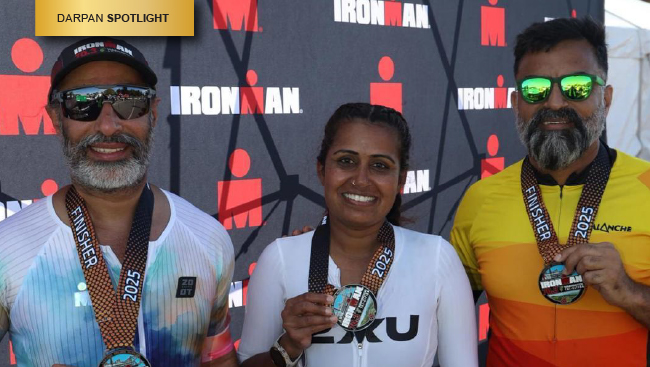
Over the next few years, Dhaliwal immersed himself in endurance sports. He climbed Mount Baker and Mount Rainier. He summited Mount Manaslu, the eighth-highest mountain on Earth, and pushed himself into unfamiliar territory through marathons, triathlons, and Ironman competitions. He completed his first Ironman in Washington and ran his first full marathon in Los Angeles just months before his Everest attempt.
Behind the scenes, the dedicated athlete’s preparation became almost scientific, as he worked with running coaches, strength trainers, and endurance specialists. Furthermore, before Everest, Dhaliwal spent three months working with a yoga instructor to improve breathing efficiency and recovery. He highlights, “Yoga taught me how to use oxygen effectively and recover properly."
Dhaliwal’s first Everest attempt, however, ended in disappointment when he was forced to turn back from Camp 4 in 2025. Though many climbers never return after a failed summit bid, Dhaliwal viewed it differently: "I wasn't sad when I came back. I just knew I had more work to do." The failed expedition became a turning point rather than a setback. Returning home, Dhaliwal focused on refining every aspect of his preparation before making another attempt the following year.
This time, he reached the summit.
Yet, the greatest challenge was still ahead. During the descent, Dhaliwal became separated from his support team in the Death Zone, the area above 8,000 meters where oxygen levels are too low to sustain human life for extended periods. His oxygen supply ran dangerously low. Conditions deteriorated rapidly. At one point, he suffered a severe fall and lost consciousness.
Many climbers have succumbed to such circumstances. Dhaliwal credits both faith and mental discipline for helping him survive. "Chardikala," he says, referring to the Sikh principle of resilient optimism. "When I was in the Death Zone, the positivity from Gurbani kept me alive. What I wanted to preach, God made me practice very fast." Eventually, fellow climbers and Sherpas located him and helped guide him back to safety. "One thing I learned is not to panic in a crisis," he emphasizes. "Otherwise, your thought process shuts down. If you don't panic, you can find solutions."
When he returned home, family members were relieved simply to see him alive. "Everyone was so happy that I had come back in one piece," he says with a laugh. "They told me, 'This is the last adventure.'" In fact, at various points in his journey, family members questioned whether the risks were worth it. Yet support eventually outweighed hesitation.
That close brush with danger also left a lasting impact on Dhaliwal himself, reshaping how he views the small comforts of everyday life. "We were thirsting for every sip," he remembers. "I got about 200 milliliters of hot water, and with that I brushed my teeth, washed my hands, and rinsed my face. I value everything more now and take nothing for granted."
That shift in perspective has also shaped the message he now shares with others about human potential. "God has given us the greatest gift, our body. If you train it properly, nourish it properly, and rest properly, you can make your body do almost anything." His own story serves as evidence. He began serious endurance training at 46, long after many athletes have reached their peak. "We all make excuses that we're busy," he points out. "But if you can't give one hour to your body in twenty-four hours, everything else becomes worthless."
Even after Everest and a near-death experience, Ajaypal Singh Dhaliwal has no plans to slow down, with more climbs, marathons, and competitions ahead. While becoming the first Sikh from Canada to summit Mount Everest earned him recognition, the mountain's greatest gift was perspective. In a place where every breath mattered, Dhaliwal discovered that true achievement lies not in standing on top of the world, but in returning with greater humility, gratitude, and resilience.